Part 9. Where Does DBS Stimulate?
— Why can electrical stimulation deep in the brain help movement again?
Study Parkinson’s disease treatment long enough, and you eventually encounter the name DBS.
Deep Brain Stimulation.
It literally means placing electrodes deep in the brain and delivering electrical stimulation.
At first, it sounds strange.
If Parkinson’s disease is caused by dopamine loss, why stimulate the brain electrically instead of simply replacing dopamine?
An even more interesting question is this:
Why stimulate tiny structures such as the STN or GPi?
To understand DBS, I think we first have to see Parkinson’s disease again as a disorder of circuits.
DBS does not revive dead dopamine neurons.
It does not manufacture the dopamine that has been lost.
Instead, it changes the activity pattern of neural circuits that have become abnormally rigid and synchronized.
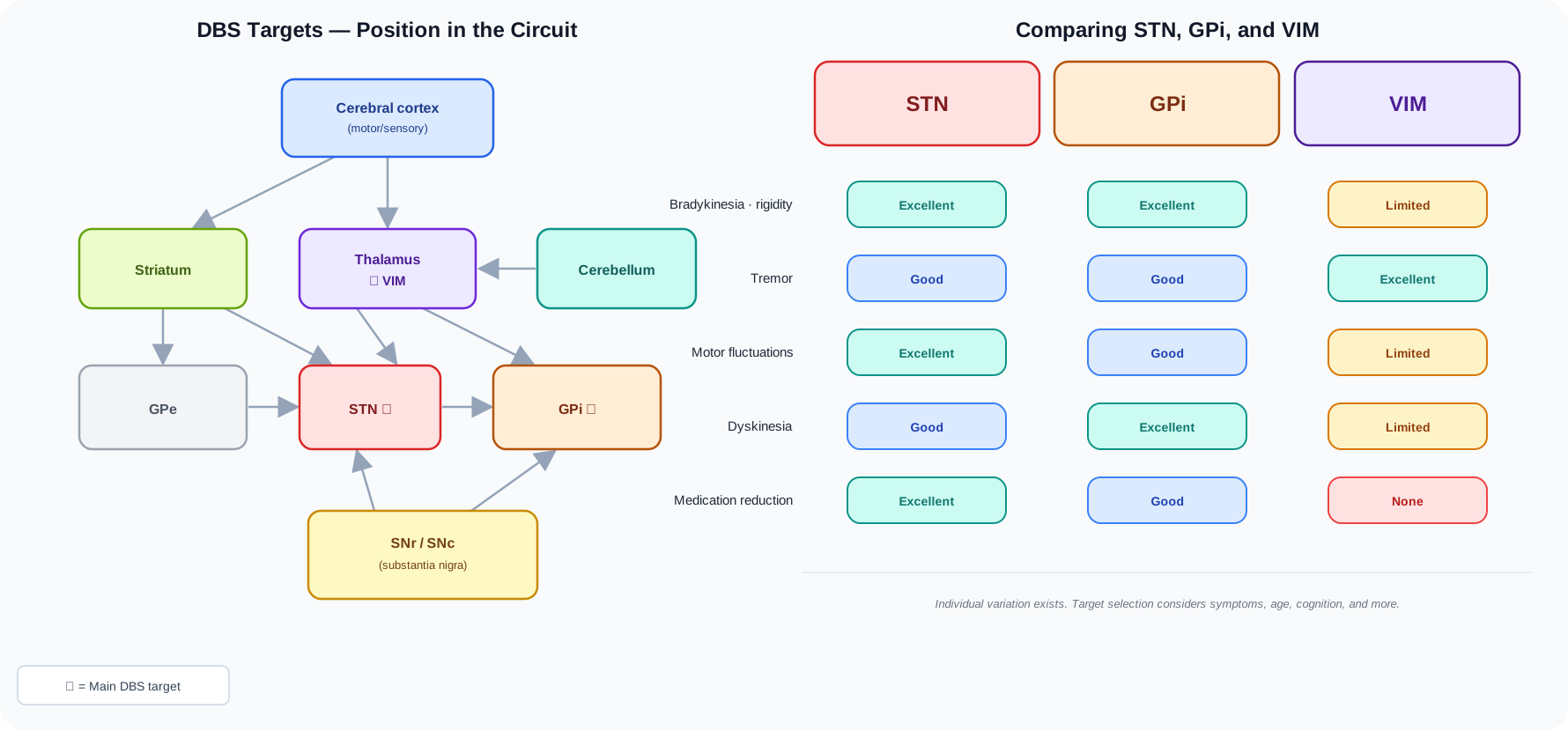
Figure. The main DBS targets — STN, GPi, and VIM — occupy different positions within the motor network.
1. Back to the basal ganglia circuit
We have returned repeatedly to the same circuit:
cerebral cortex
↓
striatum
↓
globus pallidus and subthalamic nucleus
↓
thalamus
↓
back to motor cortex.
In normal movement, this circuit continuously regulates whether to move, how much to move, and which movements should be suppressed.
Dopamine is an important modulator of this balance.
In Parkinson’s disease, dopamine loss disrupts that balance.
Basal ganglia output shifts toward excessive inhibition of the thalamus, reducing movement-promoting drive back to motor cortex.
That is one reason the body becomes slow and rigid.
2. Where is the STN?
STN stands for subthalamic nucleus.
It is a very small structure, but it occupies a strategically important position within the basal ganglia circuit.
It plays a key role in the indirect pathway and in the hyperdirect pathway.
Put very simply, the cortex → STN → GPi → thalamus route contributes to rapidly suppressing movement.
In a normal state, that is useful for stopping unnecessary actions.
In Parkinson’s disease, however, STN activity can become abnormally increased and excessively synchronized.
So the problem is not only that “the STN fires too much.”
What matters is that many neurons become locked into the wrong rhythm together.
3. In Parkinson’s disease, the circuit becomes ‘rigid’
Normal basal ganglia activity is flexible.
Firing patterns change according to context.
In Parkinson’s disease, abnormal synchronization at certain frequencies becomes more prominent.
In particular, excessive synchronization of beta-band activity in STN-related networks has been studied in association with bradykinesia and rigidity.
A simple analogy is this:
In a healthy brain, each instrument in an orchestra can adjust freely to the moment.
In Parkinson’s disease, too many instruments become locked to the same beat.
Because they are all bound to one rhythm, starting a new movement becomes harder.
I find it useful to think of this as rigidity of the motor circuit.
4. DBS does not simply ‘turn on’ the STN
When people first hear about DBS, they may imagine this:
“Is it stimulating an underactive area to make it more active?”
STN DBS is not that simple.
In Parkinson’s disease, the STN may already be overly active or abnormally synchronized.
Yet high-frequency stimulation can improve symptoms.
Why?
The exact action of DBS is still not explained by one single mechanism.
Neurons near the electrode, axons, incoming signals, outgoing signals, and the connected network can all be affected.
What matters is that DBS ultimately disrupts and retunes pathological firing patterns and abnormal network synchronization.
Rather than seeing DBS as a simple ON/OFF switch, it is often easier to think of it as a treatment that breaks the wrong rhythm.
5. Why can STN stimulation make movement easier?
In Parkinson’s disease, the STN drives the GPi strongly.
The GPi inhibits the thalamus.
So a simplified flow can be:
increased STN activity
→ increased GPi output
→ increased thalamic inhibition
→ reduced motor-cortical activity.
If that circuit becomes too strong, the gate for movement becomes too closed.
STN DBS modifies this abnormal circuit activity.
As a result, the motor network linking thalamus and motor cortex can operate in a more functional pattern.
That is why levodopa-responsive motor symptoms such as bradykinesia, rigidity, tremor, and motor fluctuations may improve.
6. Why can medication often be reduced after STN DBS?
One important feature of STN DBS is that many patients can reduce dopaminergic medication after surgery.
This is because STN stimulation itself can improve the motor circuit substantially.
That can be especially meaningful in patients who move well when medication works but whose benefit has become short, whose OFF periods recur through the day, or whose dyskinesia worsens when medication is increased.
The idea is to reduce sharp medication peaks and deep troughs while DBS supports a more stable motor baseline.
Both STN and GPi DBS can improve motor symptoms, but STN DBS generally tends to permit a larger reduction in dopaminergic medication.
7. Where is the GPi?
GPi stands for globus pallidus internus.
It is a major structure in the basal ganglia motor circuit because it is one of the principal output nuclei of the basal ganglia.
Its inhibitory signals project to the thalamus.
In that sense, it acts like a gateway through which the result of basal ganglia processing is delivered to the thalamus.
Normally, it maintains an appropriate level of inhibition.
In Parkinson’s disease, that inhibitory output can become excessive.
8. GPi is closer to the ‘exit’ of the circuit
If the STN is an important regulator within the circuit, the GPi sits closer to the final output.
Stimulating the GPi is therefore similar to directly modifying the abnormal output pattern that the basal ganglia send toward the thalamus.
GPi DBS can improve bradykinesia, rigidity, tremor, and motor fluctuations.
A particularly important advantage is its direct antidyskinetic effect.
Overall motor benefit from STN and GPi is broadly comparable, but target choice depends on individual factors such as the need to reduce medication, the severity of dyskinesia, cognition, and psychiatric status.
9. Why can GPi be attractive when dyskinesia is severe?
In Part 6, we looked at dyskinesia.
Repeated dopaminergic stimulation, striatal hypersensitivity, changes in the direct pathway, and altered glutamatergic signaling can all contribute to excessive involuntary movement.
The GPi is a final output gateway through which these basal ganglia signals reach the thalamus.
By modifying abnormal GPi output, DBS can change the way excessive motor signals are transmitted toward motor cortex.
That is why GPi can be an attractive target when dyskinesia itself is a major treatment goal.
10. So which is better, STN or GPi?
There is no single answer.
Both targets can improve the major motor symptoms of Parkinson’s disease.
They have been compared for many years, and in terms of overall motor benefit, it is difficult to say that one is universally superior for every patient.
STN
It can be an important option when the goal is to improve motor symptoms while also substantially reducing medication.
GPi
It can be especially attractive when the goal is to improve motor symptoms while actively suppressing dyskinesia itself.
But this is not a simple formula.
Age, cognition, psychiatric symptoms, speech, gait, medication response, dyskinesia, and the patient’s own treatment goals all have to be considered.
In other words, choosing a DBS target is not just a circuit decision.
It is a whole-patient decision.
11. Why does VIM stimulation reduce tremor?
In Part 7, we discussed Parkinsonian tremor as involving a somewhat different circuit.
The key network there was the cerebellar–thalamic–cortical circuit.
The VIM, or ventral intermediate nucleus of the thalamus, is closely linked to this tremor network.
Stimulating the VIM can therefore reduce tremor very effectively.
But it has an important limitation.
VIM DBS mainly treats tremor. It does not adequately treat other core Parkinsonian motor symptoms such as bradykinesia, rigidity, or motor fluctuations.
That is why STN or GPi are more commonly selected in Parkinson’s disease, while VIM is considered mainly when tremor is the dominant problem.
12. The effect of DBS depends on where you stimulate
This is why neuroanatomy matters.
Electrical stimulation does not have the same effect everywhere in the brain.
Stimulating the STN modifies abnormal motor-network activity within the basal ganglia.
Stimulating the GPi directly modifies a major basal ganglia output signal.
Stimulating the VIM strongly influences the cerebellar–thalamic–cortical tremor circuit.
So DBS is not simply “putting electricity into the brain.”
It is more accurately understood as finding a critical node in the circuit that generates the symptom and changing the activity of that network.
13. DBS is not a surgery that destroys brain tissue
In the past, lesion procedures were used to destroy selected parts of abnormal motor circuits.
DBS is different.
Rather than permanently destroying tissue, it delivers electrical stimulation through implanted electrodes.
The amplitude, frequency, pulse width, and active contacts can all be adjusted.
That means programming can continue after surgery to balance benefit and side effects.
I think this is an important part of understanding DBS.
The treatment does not end when the operation is over.
That is when a new process begins — balancing electrode location + stimulation settings + medication.
14. The electrode works in a very small region
The STN is very small.
Around it are densely packed fibers and structures serving different functions.
So electrode placement and the choice of active contact matter greatly.
If current spreads in a slightly different direction, it can affect not only motor benefit but also speech, muscle contraction, sensation, eye movement, mood, or behavior.
For this reason, modern DBS is moving beyond simply targeting one anatomical nucleus and toward considering the networks and fiber pathways that pass through and around it.
15. Why is DBS especially meaningful for OFF?
Some patients move relatively well when levodopa works but develop severe OFF when its effect wears off.
In that situation, motor function has not disappeared completely.
The fact that the circuit works again when dopamine is available shows that part of the dysfunction remains reversible.
DBS can help stabilize that circuit, reduce OFF time, and smooth motor fluctuations.
That is why levodopa responsiveness is a very important part of DBS evaluation.
In general, DBS works best for motor symptoms that respond well to levodopa.
16. DBS does not solve every symptom
This point is crucial.
DBS does not eliminate Parkinson’s disease.
It has not been established as a treatment that stops disease progression.
And not every symptom improves equally.
Bradykinesia, rigidity, tremor, motor fluctuations, and dyskinesia can respond well.
But some later problems — balance impairment, speech difficulty, swallowing difficulty, cognitive change, and autonomic symptoms — may not improve sufficiently.
In particular, axial symptoms that respond poorly to levodopa often respond poorly to DBS as well.
So DBS should not be understood as a treatment that “makes the patient normal again.”
17. Then what is the real goal of DBS?
I think the most realistic goal is this:
not to create the highest possible ON,
and not to eliminate the disease,
but to reduce deep OFF periods, severe motor fluctuations, medication-resistant tremor, and dyskinesia so that the amount of usable good time becomes wider.
This connects directly with what I have learned from recording my own medication response.
A brief 100-point moment may matter less in real life than avoiding a drop to 20 and sustaining 70–80 for much longer.
DBS understood through my own body
For a long time, while taking medication and watching my body change, I thought of Parkinson’s disease mainly as a problem of dopamine concentration.
Medication rises, and I move.
Medication falls, and I cannot move.
But studying neuroanatomy again added another layer.
What medication changes is ultimately the circuit.
And what DBS changes is also the circuit.
The methods are different.
Medication uses chemical signals.
DBS uses electrical stimulation.
Both ultimately alter the network state among the basal ganglia, thalamus, and motor cortex.
That is why DBS now feels a little less strange to me.
It is not forcing the body to move by putting electricity into the brain.
It is closer to introducing a different rhythm into a motor circuit that has become pathologically locked.
The STN is an important regulatory node.
The GPi is a major output structure.
The VIM is an important gateway in the tremor circuit.
Where to stimulate therefore comes back to one basic question:
which circuit is producing the symptom we most want to change?
And that is why DBS looks different after studying neuroanatomy.
Part 9 in one line
DBS does not replace missing dopamine. By stimulating key nodes such as the STN, GPi, and VIM, it retunes pathological firing patterns and abnormal network synchronization in Parkinson’s disease.