Part 4. Why the Feet Stick to the Floor — Freezing of Gait and the Walking Circuit
In Parkinson’s disease, the symptom where the feet will not lift, as if frozen — freezing of gait (FOG) — is not caused by muscle weakness.
The intention to move is there. What stops, for a moment, is the circuit that produces the “first step.”
Part 3 looked at how the basal ganglia open and close the gate of movement. This time we follow the road beyond that gate — the path all the way to the foot actually stepping out. FOG is a failure of complex integration: the gait circuit that runs from the basal ganglia through the cortex, thalamus, and brainstem to the spinal cord, working together with attention, visuospatial information, and the postural control system.
Chapter 30. The first step is especially hard — gait initiation is not simple muscle weakness
FOG is a problem in the early stage of “planning and starting movement.”
Even when muscle strength and the joints are normal, the feet stick to the floor when the starting signal for the “first step” fails to form, or when several circuits fall out of sync with one another.
This tends to happen especially when rising from sitting, crossing a threshold, or turning.
In other words, this is a failure of initiation — the starting of a motor act — not a lack of muscular force. FOG is where the sentence I wrote in Part 2, “I can move — but movement does not come out easily,” shows itself in its most extreme form, in walking.
Chapter 31. Walking is a cooperation of circuits
Walking is not the product of a single region. It is the result of a “network” — multiple brain regions and the spinal cord tightly linked together.
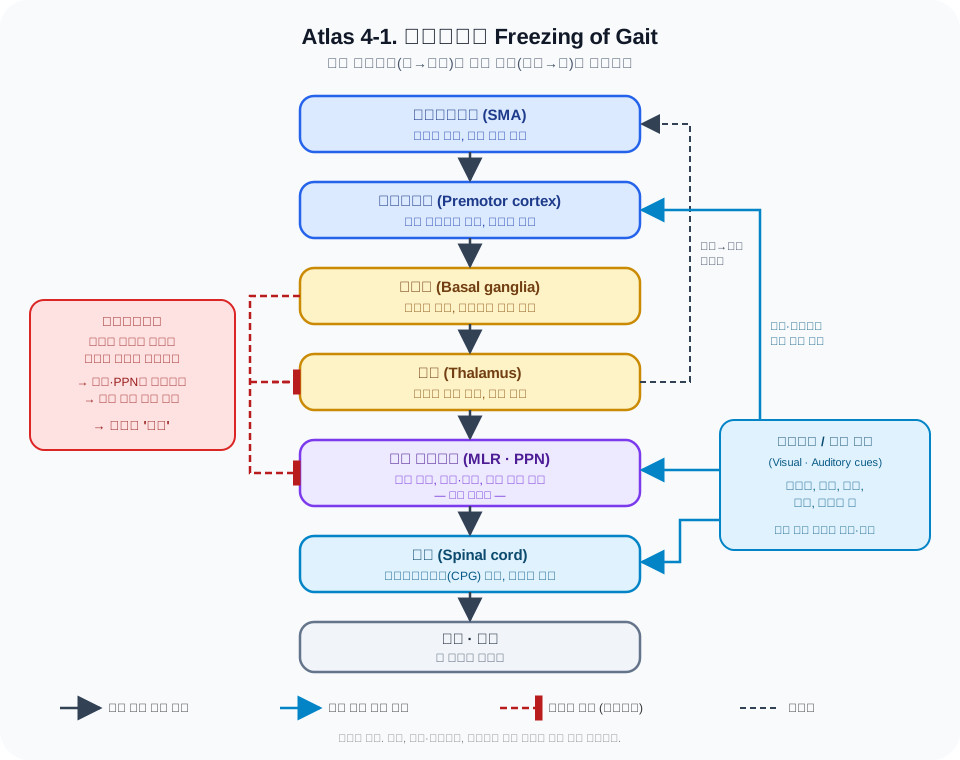
Follow Atlas 4-1’s vertical line from top to bottom, and this is what you find.
The supplementary motor area (SMA) plans the movement and generates the starting signal. The premotor cortex selects the motor program and prepares its sequence. The basal ganglia select the movement and suppress unnecessary activity. The thalamus relays information to the cortex and helps set the rhythm. The mesencephalic locomotor region (PPN and MLR) generates the rhythm and starts posture, balance, and gait initiation. The spinal cord’s central pattern generator (CPG) turns the beat of the step and commands the muscles. And one step is realized.
The movement planned in the cortex passes through the basal ganglia and returns to the thalamus; the brainstem gait circuit generates rhythm and posture; the cerebellum refines timing and coordination; and the spinal cord carries out the concrete gait pattern.
This multilayered circuit integrates sensory information and external cues at every moment to produce “one appropriate step.” The feet stop not when any single layer fails, but when the connection between layers breaks.
Chapter 32. PPN and MLR — the brainstem gait network and gait initiation
The brainstem holds the key switch that sets off walking.
The mesencephalic locomotor region (MLR), especially the pedunculopontine nucleus (PPN) and the reticular formation, generates “gait rhythm” and “postural maintenance,” and sends the first-step signal down to the spinal cord.
When the signal from the basal ganglia weakens, PPN activity cannot rise enough. The gait-start switch does not get pressed, and the foot will not lift.
Part 3 described GPi/SNr as the brake that inhibits the thalamus. The same output nuclei also inhibit the PPN. When that brake is set too hard in Parkinson’s disease, not only the thalamus but the brainstem gait switch ends up held down too. The red dotted line in Atlas 4-1 is that excessive inhibitory pathway.
Chapter 33. Why freezing happens at thresholds, turns, and narrow spaces — the doorway effect, turning, dual task, and cognitive load
Thresholds, elevators, doorways, turns, and narrow hallways all demand visuospatial recalculation and a shift of attention.
When the automatic gait circuit becomes overloaded at these moments, the “search” for the next step takes longer, uncertainty grows, and freezing occurs.
Dual tasks — conversation, doing arithmetic, using a phone — also pull attentional resources from the prefrontal cortex, weakening the starting signal of the gait circuit.
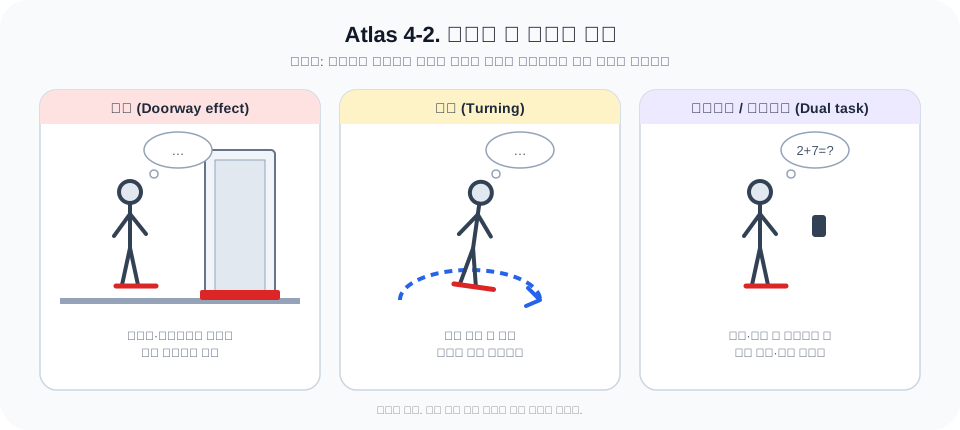
Atlas 4-2 shows the three scenes. In front of a doorway or an elevator, the foot will not lift. When changing direction, the foot sticks to the floor and hesitates. Under distraction — conversation, doing arithmetic — starting or continuing gait becomes hard.
There is one thing in common. Freezing happens when “thought” suddenly intrudes into gait that had been running automatically.
Chapter 34. Why external cues help
External cues reduce the internal circuit’s uncertainty by supplying a “path” and a “rhythm.”
A line on the floor, the sound of a metronome, stairs, a laser line — these work through the senses to activate the gait circuit directly, or to wake the rhythm of the PPN and the spinal cord, making the first step possible.
They serve to bypass or support the damaged internal starting circuit.
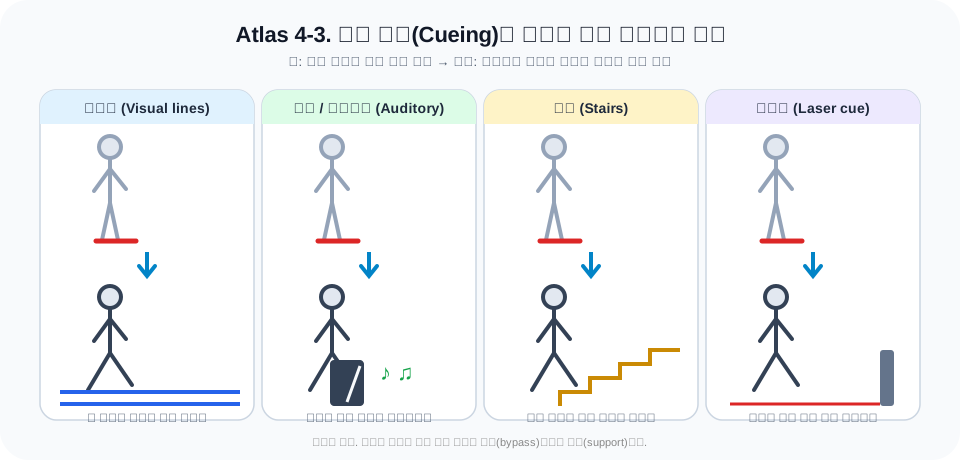
Atlas 4-3 shows the four scenes. Following a line, the first step lifts easily. Matching a rhythm, the stride becomes regular. A stair cue helps start walking. Following a laser line, the foot moves.
Part 2, Chapter 16 asked, “Then why does a single line restore movement?” The answer is here. The line supplies, from outside, the starting signal the inside could not produce.
Chapter 35. Why this is not the basal ganglia’s problem alone
FOG is grounded in basal ganglia dysfunction, but it also needs the frontal lobe’s attention and decision-making, the parietal lobe’s visuospatial integration, the cerebellum’s timing and prediction, and postural stability from the vestibular and somatosensory systems, all working together.
If even one of these falters, the cooperation of the gait circuit breaks down, and freezing is easily triggered.
So managing cognition, attention, balance, and posture together is what makes the approach effective. This is why dopaminergic medication alone does not fully resolve FOG.
Chapter 36. Why gait differs between ON and OFF
In ON (the stretch when the medication is responding), dopamine reduces the unnecessary inhibition in the basal ganglia circuit. The gait-initiation signal passes through more easily, the connection between the PPN and the cortex runs more smoothly, and the first step comes.
In OFF (the stretch when the medication’s effect has faded), inhibition dominates, the starting signal weakens, and freezing becomes more frequent.
This is closer to “the internal ignition being switched off” than to “the body feeling heavy.”
This is exactly the difference between the two evenings I wrote about in the pharmacology special edition. Even within the same ON, the evening when the automaticity of walking returned and the evening when consciousness had to drive each step one at a time — the difference was whether this circuit’s ignition had turned over, or was still sitting below threshold.
Chapter 37. The difference between freezing and festination
FOG is a state where the foot “sticks” to the floor and will not move. Festination is a state where the body is “pushed” forward and the steps speed up, growing smaller.
The core mechanism of the first is a “failure to start”; of the second, a “failure to brake.” The treatment strategies differ accordingly.
The two can alternate in the same person. The feet stick in front of a threshold, and then, as it releases, the small steps speed up and the body pitches forward. Recording the two separately makes it possible to tell a different story in the clinic.
Chapter 38. Summary — why the feet stick to the floor, and what it teaches us
- The problem of the first step: FOG is a problem of the circuit, not of strength. The intention to move is there, but the starting circuit momentarily loses its connection.
- The circuit’s stall: dopamine falls → inhibition dominates in the basal ganglia → the starting signal to the thalamus and cortex weakens → the ignition signal to PPN, MLR, and the spinal cord weakens → the foot “sticks.”
- Situational factors: thresholds, turns, narrow spaces, and dual tasks demand visuospatial recalculation and shifts of attention, overloading the circuit.
- The power of external cues: visual, auditory, and tactile cues bypass the damaged internal circuit and supply the rhythm and direction of gait.
- An integrated approach: when medication, rehabilitation, external cues, and training in cognition, balance, and posture come together, “stopping” can turn into “moving.”
Key points
- FOG is not a problem of muscle strength — it is a “temporary stall of the gait-initiation circuit.”
- The brainstem gait circuit, including the PPN and MLR, acts as the switch for the first step.
- Situations like thresholds, turns, and dual tasks trigger overload in the circuit.
- External cues bypass and support the circuit, making the first step possible.
- Integration matters — not only the basal ganglia but the frontal lobe, parietal lobe, cerebellum, and the sensory and postural systems together.
Tips for the clinic and daily life
- At a doorway, pause for a moment, and find or create a line on the floor to start the first step.
- Set a rhythm before walking (a metronome, a song), and keep your attention focused on walking.
- Practice turning with “small steps plus a fixed gaze plus rhythm.”
- When needed, make active use of a walking aid, a laser cue, or line tape.
Closing Part 4
At the end of Part 2 I asked: if the basal ganglia are the system that selects movement, why do the feet, at certain moments, truly not move — as if stuck fast to the floor?
Now I can answer. The feet do not stick because they lack strength. It is because the ignition circuit that sends out the first step loses its connection in that moment. And that circuit is not the basal ganglia alone — it is a cooperation running from the cortex through the brainstem and spinal cord, together with attention and sensation.
That is why a single line, a single sound, can set the foot moving again. A cue coming in from outside starts the ignition that was cut, in its place.
Appendix. Why Can I Drag My Feet but Not Lift Them During Dyskinesia — and Why Do I Walk Better on Sand?
This appendix began with a single entry in my record.
At the height of dyskinesia, lifting my leg to walk did not work. But dragging my foot along the ground did. A few days later, on a dirt path and on sand, I actually walked better than on flat, paved ground.
It is the same leg, the same muscles. What is different?
The answer is that even the same act of “walking” can lean on different circuits.
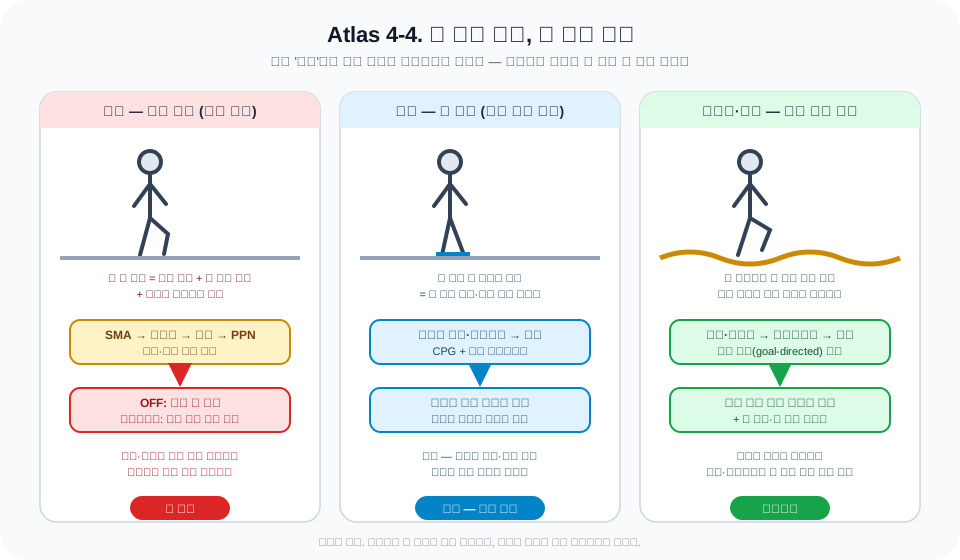
Lifting the leg to walk is the most “selective” act
To lift one foot, you first have to shift your weight to the opposite side, balance while standing on one leg, and fire hip flexion at exactly the right instant. That sequence only comes out when the supplementary motor area, the basal ganglia, the thalamus, and the cortex work together with the postural system running from the brainstem PPN through the reticulospinal tract.
In Chapter 27 I wrote that the first step is a matter of switching between several motor programs in a brief instant. The swing phase of a step is the stretch where that switch repeats with every step. This is exactly the part of walking that demands the most from the basal ganglia’s selection function and from the balance system.
Dyskinesia is the selection function broken in the opposite direction
OFF is the GPi/SNr brake set too hard, so the gate will not open. Dyskinesia is the opposite. With too much dopamine, the brake is released too far, the thalamus is disinhibited, and even motor programs that were never selected leak through. The indirect pathway from Part 3, Chapter 21 — the road that suppresses competing movement — stops doing its job.
So the instant I try to lift a leg, involuntary movement cuts into the trunk, pelvis, and hip, shaking the weight shift and the single-leg stance, and the flexion command gets mixed in with other commands, so a clean swing never comes out.
Walking fails not because the gate is closed but because too many gates are open. OFF and dyskinesia are opposite states, but both break down the swing phase first.
A dragging gait bypasses that circuit
Pushing forward with the foot kept on the floor means both feet stay in contact at all times. Neither single-leg stance nor the postural preparation for a weight shift is needed. The demand on balance drops to a minimum.
Instead, plantar pressure and joint position sense pour into the spinal cord at every moment. The spinal cord’s central pattern generator and the brainstem reticulospinal tract use that sensation as a beat to build the forward-pushing force. It is a lower-tier circuit, one that depends less on the basal ganglia’s precise selection and timing.
The principle is the same as the external cues in Chapter 34. What a line on the floor does through vision, contact with the floor does through touch and proprioception. This is also why, even in OFF, walking by lifting the leg fails while dragging can still remain.
Still, though dragging makes sense in circuit terms, it comes at a cost. The stride shortens, posture bends forward, and there is a risk of the toe catching and a fall, along with added strain on the knee and ankle. It is an emergency route, not an answer.
Why do I actually walk better on sand and dirt paths
At first this looks like a contradiction — walking improving on ground that is harder than flat pavement.
But seen through the circuit, it makes sense. On sand, three things happen at once.
First, walking shifts from automatic to conscious. Because you have to check where to place your foot with your eyes at every step, the goal-directed circuit — running from vision and the parietal lobe through the premotor cortex to the cerebellum — takes over the walking. What is broken in Parkinson’s disease is the basal ganglia circuit responsible for habitual, automatic gait; the circuit that moves by looking at a target is relatively preserved. It has long been known that people who freeze on flat ground walk well in front of stairs or obstacles, and that is exactly what sand does. It turns every single step into a “stair.”
Second, sensory feedback grows larger. Sand gives way and wraps around the foot with every step. The pressure and position sense rising from the sole, ankle, and knee are far stronger and more variable than on flat ground. The sensory-driven circuit seen in dragging gait ends up receiving a stronger input.
Third, small steps are not allowed. On sand you cannot drag your foot; you can only move forward by lifting it. The ground forcibly corrects the reduced amplitude that is the core problem of Parkinsonian gait. The terrain stands in for the rehabilitation principle of repeatedly training large movements.
There is one more thing. On sand, a fall hurts less. When the fear of falling eases, the inhibition the frontal lobe places on walking loosens. That fear itself can be a factor that freezes gait is something I already experienced in front of a threshold.
What to put in the record
What I take from this appendix is that “quality of gait” needs to be recorded along three separate lines.
Can I walk by lifting my feet? Can I only drag them? Does it change depending on the ground?
With these three lines, even the same clock time in ON can be told apart — an ON where the automatic circuit is alive, an ON getting by on the lower-tier circuit, or an ON where the goal-directed circuit is doing the walking instead. Chapter 36 described the difference in gait between ON and OFF; in reality, these three layers sit in between.
This appendix interprets a personal observation through a circuit model. Both dragging gait and walking on uneven terrain carry a risk of falling, so any attempt should be made in a safe setting, with a caregiver present, and discussed with the treating clinical team.
This article is written to help explain movement in Parkinson’s disease and is for educational purposes. If freezing of gait is frequent or falls occur, discuss this with your treating clinical team, and any change in the type, dose, or timing of your medication must be decided together with your medical team.