Pharmacology Through My Own Body, Special Edition 2 — Dopamine Efficiency: Not How Much, But How Well
Lately, looking back over what has piled up in my medication diary, one phrase keeps coming to mind.
Dopamine efficiency.
It is not a medical term. It is a phrase I gave my own records so I could explain them to myself. But only after I gave it that name did the last several years of prescription changes start to read as a single story.
The period when raising the dose was my whole response
Around the time my Parkinson’s disease moved into its middle stage, I began to clearly experience the medication wearing off.
The discomfort and the unpleasant sensations that came each time the effect faded were bigger than I expected. The feeling of the body suddenly not listening, the stretch of time spent just waiting for the next dose to kick in — these kept breaking the day into pieces.
My response back then was simple. Every time I went to the clinic, I asked for more medication.
For a while I took Stalevo 150 mg four times a day, and added Madopar 50 mg in between doses. But even after raising the total amount that way, OFF never went away completely.
There was more medication, but the day was not necessarily easier. If anything, some days were a repeating pattern of high peaks and deep troughs. There were stretches when the effect never rose enough, and stretches, in the opposite direction, when it rose too far and brought on dyskinesia.
In Part 4, Chapter 20, I wrote that “raising the dose does not readily fill the trough.” That sentence came out of the records from this period.
The problem was not the amount, but the shape
After that, I started studying dopamine and Parkinson’s disease pharmacology again. And I recorded how my body responded.
The time of the dose. The first sign. The time ON arrived. How long it held. When it fell. The point at which dyskinesia appeared.
As I kept looking at those records, my thinking shifted a little.
The question was not how much dopamine I put in over a day. What mattered more was how long the same amount of dopamine could keep me in a state I could actually live in.
Even with the same total dose for the day, putting in a large amount at once — sending it high, then letting it fall — and holding the floor with a slow-release formulation while topping up only as needed produce entirely different curves in the body.
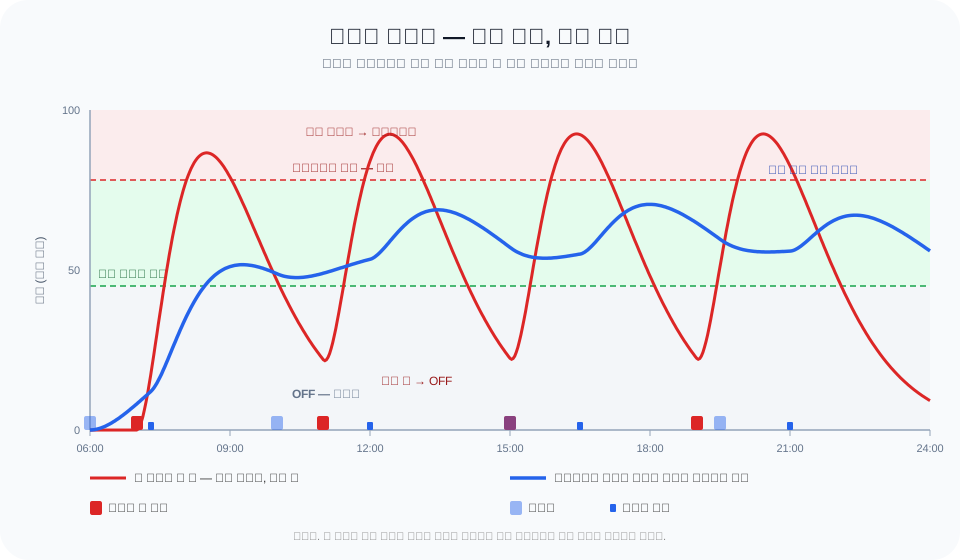
The red curve is who I used to be. Every peak crosses the dyskinesia threshold, and every trough falls into OFF. The daily total is high, but the time spent inside the livable range is short.
The blue curve is the approach I am learning now. An extended-release formulation holds the floor, and a fast-acting formulation is allowed to rise only a little, only when needed. The peaks are lower, but the time spent inside the range is much longer. The total dose actually went down.
What an actual day looks like
A concept diagram alone can be hard to trust. So here is one real record. September 2, 2026 — my day.
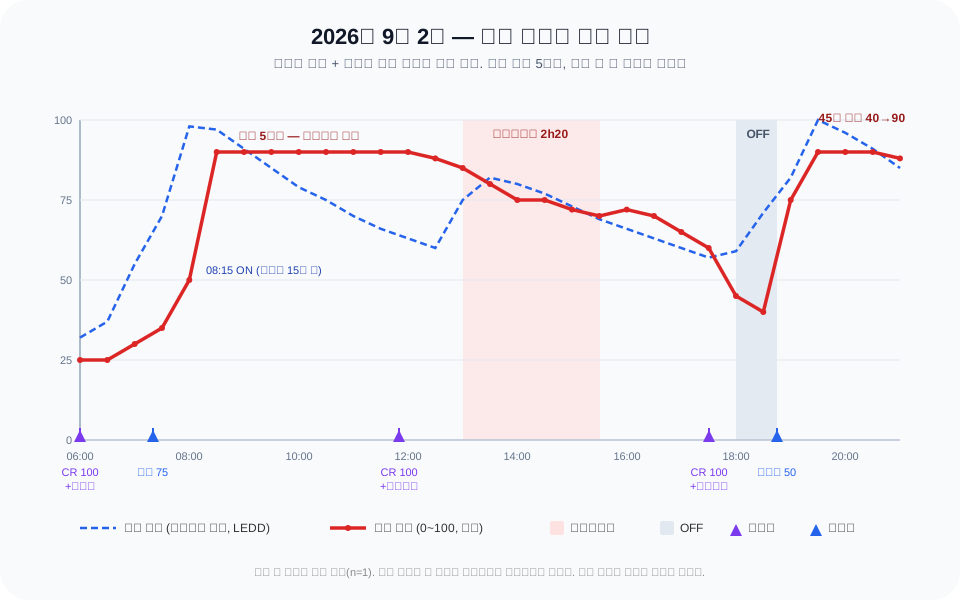
That day, three doses of extended-release 100 mg held up the floor of the day, and a morning immediate-release 75 mg and an evening diffusible tablet of 50 mg rode on top of it.
After the morning immediate-release dose, a plateau of output 90 lasted five hours. The engine’s prediction sloped gently downward, but the actual measurement stayed flat. My body’s plateau held up more solidly than the model’s arithmetic sum.
In the afternoon there was dyskinesia for 2 hours 20 minutes. It happened where the morning layer lingered longer than expected and the midday extended-release dose stacked on top of it. It was the only stretch that day where things “overflowed,” and it points to where I need to make the next adjustment.
The trough came in the evening. Output 40. But it was a slope, not a cliff. The extended-release tail was draining off slowly, and the background medication was still holding up the floor beneath it, so it was a different kind of OFF from the abrupt drop of the Stalevo years. And 45 minutes after the 50 mg diffusible tablet, output rose from 40 to 90.
The daily total of levodopa is lower than in the days when I took Stalevo 150 mg four times. And yet the time spent in the livable range was longer, and even the OFF was gentler.
This is what I mean by dopamine efficiency.
If I were to define it
To me, dopamine efficiency means this.
How much stable function I get, relative to the amount of levodopa I put in, and for how long.
High efficiency does not mean creating the single highest moment of drug effect. It is not about hitting output 100 a few times. It is closer to avoiding peaks that are too high, keeping the OFF troughs from being too deep, and staying inside a livable range for as long as possible.
This involves more than just the amount of medication. The combination of extended-release and immediate-release. The interval between doses. Meals. The state of the stomach. How much effect is left over from the day before. The depth of OFF. The threshold at which dyskinesia begins. All of these go into it together. What I wrote in Part 4, Chapter 23 — “interval over dose” — comes down to the same story.
Of course, this is not a standardized measure. It is a concept I made up to explain the record of my own body. But the direction is not different from medicine’s own. It has long been discussed, in treating Parkinson’s disease, that a steadier stimulation reduces dyskinesia and fluctuation more than a stimulation with large swings, and that treatments like extended-release formulations, continuous infusion, and pumps rest on that same principle. I seem to have rediscovered that principle on the curve of my own day.
The question changed
I used to think, when OFF came:
“The medication isn’t enough. I need to take more.”
Now the question is different.
Is dopamine actually insufficient right now? Or has absorption simply been delayed? Is the earlier dose still on its way up? Is the peak already high enough, but the trough too low? Can the same total dose make a flatter curve?
This change in the question may be the biggest change in the pharmacology I have relearned.
The goal of drug treatment in Parkinson’s disease is probably not to put in as much dopamine as possible. It is to use the amount of dopamine my body needs, at the time it needs it, as stably as possible.
That is what I think of as dopamine efficiency.
And the curves piling up day after day in my medication diary are becoming the record of that search for efficiency.