Appendix 4. Corticobasal Syndrome (CBS)
— Why won’t one side of the body move the way I intend?
Among the parkinsonian syndromes, corticobasal syndrome (CBS) is particularly distinctive.
Its name points to two systems at once.
Cortical — the cerebral cortex.
Basal — the basal ganglia.
In other words, CBS is a syndrome in which dysfunction of the cerebral cortex and basal ganglia appears together.
So CBS does not produce only bradykinesia and rigidity.
One arm or leg may become severely slow and stiff.
A person may know what action they want to perform but be unable to carry it out properly because of apraxia.
They may feel sensory input but fail to interpret its meaning, or one hand may feel almost as though it belongs to someone else — an alien limb phenomenon.
This is where CBS begins to look very different from Parkinson’s disease despite some outward similarities.
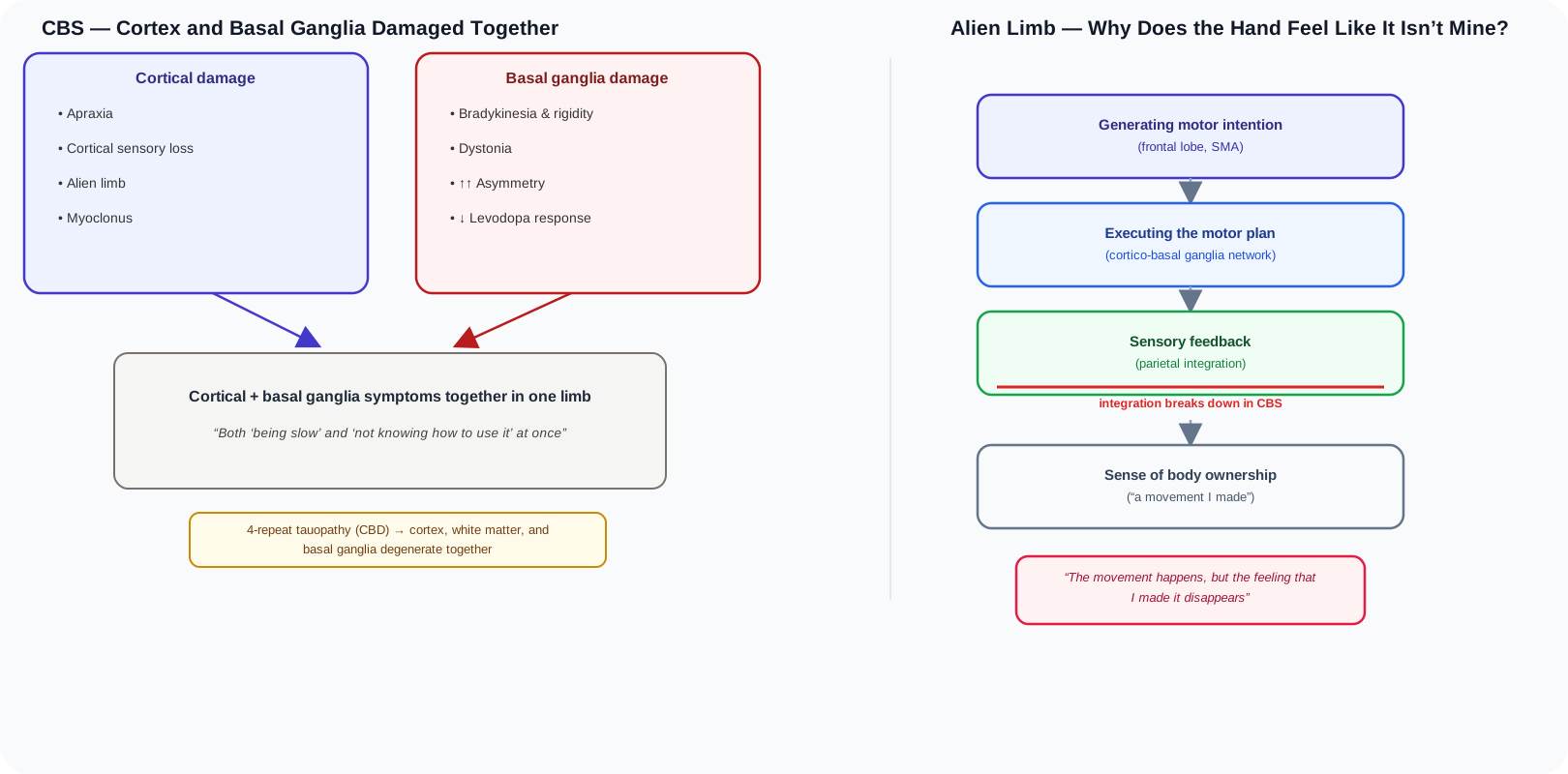
Figure. In CBS, cortical features and basal-ganglia motor features may converge in the same limb. Alien limb phenomena can emerge when intention, motor planning, sensory feedback, and the sense of ownership are no longer integrated normally.
1. Why is CBS called a syndrome?
This distinction is important from the start.
CBS is the name of a clinical syndrome.
It describes a particular combination of symptoms and signs.
Several different pathological diseases can produce that clinical picture.
One of the most representative is corticobasal degeneration (CBD).
CBS and CBD were once often used almost interchangeably, but it is more accurate to distinguish them.
CBS is the clinical phenotype.
CBD is the pathological diagnosis.
So a patient with CBS does not necessarily have CBD pathology.
2. Why is one side often much worse?
One of the most important features of CBS is marked asymmetry.
Symptoms often begin much more severely in one arm or leg.
One hand may stiffen.
One arm may become difficult to use.
One leg may become uncomfortable or clumsy.
Parkinson’s disease can also begin asymmetrically, which can make the early distinction difficult.
But in CBS, the asymmetry often includes cortical dysfunction on the same side, not only bradykinesia and rigidity.
For example, the right arm may not only become slow; the patient may also lose the ability to perform a familiar learned action with that arm.
3. Apraxia is not caused by weakness
One of the key symptoms of CBS is apraxia.
Apraxia is not simply inability to move because of weakness.
It is not paralysis.
It is not complete sensory loss.
The patient knows what they are being asked to do.
But the action cannot be properly organized and executed.
For example, if asked to “show how you would comb your hair,” the patient may have enough strength but fail to form the correct hand posture or movement direction.
The problem lies not in movement itself but in turning a motor plan into organized action.
4. Why does apraxia happen?
A familiar skilled action requires several brain regions to work together.
The parietal lobe integrates information about objects and space.
Premotor cortex prepares the sequence of an action.
Motor cortex generates the actual muscle command.
The basal ganglia help select and initiate the appropriate motor program.
In CBS, this cortical–basal-ganglia network can be damaged together.
The strength may still be present, but the blueprint for action no longer connects properly to execution.
5. What is cortical sensory loss?
Sensory abnormalities in CBS can also be distinctive.
A patient may feel an object placed in the hand yet be unable to identify it with the eyes closed.
This is called astereognosis.
A number or letter traced on the skin may also fail to be recognized; this is impaired graphesthesia.
The problem is not simply that a peripheral nerve failed to carry sensation.
The sensory information reached the cortex, but the brain could not interpret it as a meaningful form.
That is why it is called cortical sensory loss.
6. Why does alien limb occur?
One of the most striking symptoms of CBS is the alien limb phenomenon.
A patient may feel that one hand moves against their intention, is not fully under control, or even does not feel entirely like their own hand.
In some cases the hand may grasp an object and fail to release it, or interfere with what the other hand is trying to do.
This sounds strange, but it becomes more understandable through neuroanatomy.
Normally, intention, motor planning, sensory feedback, and the sense that a body part belongs to oneself are integrated into a single experience.
When networks involving the frontal lobe, parietal lobe, supplementary motor area, and corpus callosum are damaged, that integration can break down.
As a result, a movement may occur while the feeling that “I made this movement” is lost.
7. Rigidity in CBS can look different from Parkinson’s disease
Rigidity and bradykinesia can both occur in CBS.
But one limb may become extremely rigid, or its posture may become so fixed that it resembles a contracture.
Dystonia may also occur.
One arm may remain flexed, and the fingers may twist into abnormal postures.
This can look quite different from the familiar cogwheel rigidity of typical Parkinson’s disease.
8. Myoclonus may also appear
Myoclonus can occur in CBS.
The arm or hand may jerk suddenly in brief, shock-like movements.
This is different from tremor.
Tremor is relatively rhythmic and repetitive, whereas myoclonus is much briefer and more abrupt.
In CBS, abnormal excitability of cortical motor networks may contribute to these jerks.
So bradykinesia, rigidity, dystonia, myoclonus, and apraxia can all appear together in one limb.
9. Language can also be affected
CBS can affect language function as well.
In some patients, speech output becomes slow, sentence production becomes difficult, or the planning of articulation itself is disrupted.
This can appear as nonfluent aphasia or apraxia of speech.
The problem is not simply stiffness of the tongue or lips.
The left frontal-parietal network involved in planning and expressing language can itself be affected.
10. What is the pathological core of CBD?
CBD, like PSP, is a tauopathy.
More specifically, it is a 4-repeat tauopathy.
Abnormal tau protein accumulates within the nervous system.
But PSP and CBD are not the same disease simply because both are tauopathies.
The cells, regions, and distribution in which tau accumulates are different.
In CBD, tau pathology can involve both neurons and glial cells.
The cortex, white matter, and basal ganglia can all be affected.
11. Characteristic pathological findings in CBD
One important pathological finding in CBD is the astrocytic plaque.
This is a characteristic pattern of tau accumulation in astrocytes.
In PSP, the classic astrocytic lesion is the tufted astrocyte.
In CBD, the astrocytic plaque is more characteristic.
Swollen ballooned neurons may also be seen.
These differences show that even within the same family of 4-repeat tauopathies, the pathological patterns are not the same.
12. Why do cortical and basal-ganglia symptoms appear together?
CBD pathology can affect the cerebral cortex, subcortical white matter, and basal ganglia together.
That is why two types of symptoms can appear at the same time.
When cortex is affected, apraxia, cortical sensory loss, language dysfunction, and alien limb phenomena can appear.
When the basal ganglia are affected, bradykinesia, rigidity, and dystonia can appear.
That is why the syndrome is called corticobasal — cortical and basal-ganglia dysfunction appearing together.
13. Why is levodopa response often limited?
In Parkinson’s disease, the main problem is loss of nigral dopamine neurons while much of the downstream circuitry remains usable for a considerable period.
That is why levodopa can often work well.
In CBS, the problem can be much broader.
Cerebral cortex, basal ganglia, and subcortical white matter may all degenerate.
Replacing dopamine alone cannot correct apraxia, cortical sensory loss, alien limb phenomena, or severe asymmetric rigidity.
For that reason, levodopa responsiveness is usually limited.
14. The same CBS phenotype can have different underlying pathologies
This distinction is important again.
A clinical picture of CBS does not mean that the underlying pathology must be CBD.
Other pathologies can also produce a CBS phenotype.
Examples include PSP pathology, Alzheimer disease pathology, and other tauopathies.
So the outward clinical phenotype and the actual tissue pathology are not always in a one-to-one relationship.
This is one reason neurodegenerative diagnosis can be difficult.
15. What can imaging show?
MRI may show asymmetric cortical atrophy.
This can be seen particularly in the frontal lobe, parietal lobe, and perirolandic region.
But this finding is not specific.
It must be interpreted together with the clinical picture.
More important than one MRI image is which function failed first on which side.
16. Why is DBS usually not the solution?
CBS can include bradykinesia and rigidity.
That might make STN or GPi stimulation seem attractive.
But the core problem in CBS is not confined to one basal-ganglia node.
Cortex, white matter, basal ganglia, and sensory-integration networks may all be affected.
Stimulating a single basal-ganglia target therefore cannot be expected to reverse apraxia, cortical sensory loss, or alien limb phenomena.
For that reason, typical CBS is generally not considered a good indication for DBS.
CBS and PSP through the lens of pathology
PSP and CBD are both 4-repeat tauopathies.
Yet their clinical pictures are very different.
In PSP, the midbrain, brainstem, postural-control system, and vertical eye-movement network are especially important.
In CBD, the cerebral cortex, parietal lobe, basal ganglia, motor planning, and sensory integration may be affected more prominently.
The same tau protein can produce very different syndromes depending on where it accumulates, in which cells, and in what distribution.
Understanding CBS makes Parkinson’s disease easier to see
Compared with CBS, the typical features of Parkinson’s disease become clearer again.
Parkinson’s disease can also begin asymmetrically.
But early prominent cortical features such as apraxia, cortical sensory loss, and alien limb phenomena are not typical of Parkinson’s disease.
In Parkinson’s disease, movement becomes slow.
In CBS, movement can become slow and the network that knows how to carry out the movement can itself break down.
That is a major difference.
In Parkinson’s disease, the main problem may be thought of as “bringing the movement out.”
In CBS, the networks that design the movement, execute it, and recognize it as one’s own movement may all be affected.
Appendix 4 in one line
Corticobasal syndrome (CBS) is a clinical syndrome in which asymmetric parkinsonism is accompanied by cortical features such as apraxia, cortical sensory loss, alien limb phenomena, and myoclonus; corticobasal degeneration, one important underlying pathology, is a 4-repeat tauopathy affecting neurons and glial cells in cortex and basal ganglia.