Appendix 6. Parkinson’s Disease and Parkinsonism
— What Helps Tell Them Apart?
So far, we have looked at Parkinson’s disease together with
multiple system atrophy (MSA),
progressive supranuclear palsy (PSP),
corticobasal syndrome (CBS),
and dementia with Lewy bodies (DLB).
On the surface, they can all look similar.
Movement becomes slow.
The body becomes rigid.
Walking becomes difficult.
Tremor may appear in some cases.
That is why they can be difficult to distinguish early on.
But when we look more closely, each disorder differs in
its pathological protein,
the circuits it mainly affects,
and the order in which symptoms appear.
So the important question is not simply
“Are parkinsonian symptoms present?”
but rather
which symptom appeared first, and which circuit seems to have failed first?
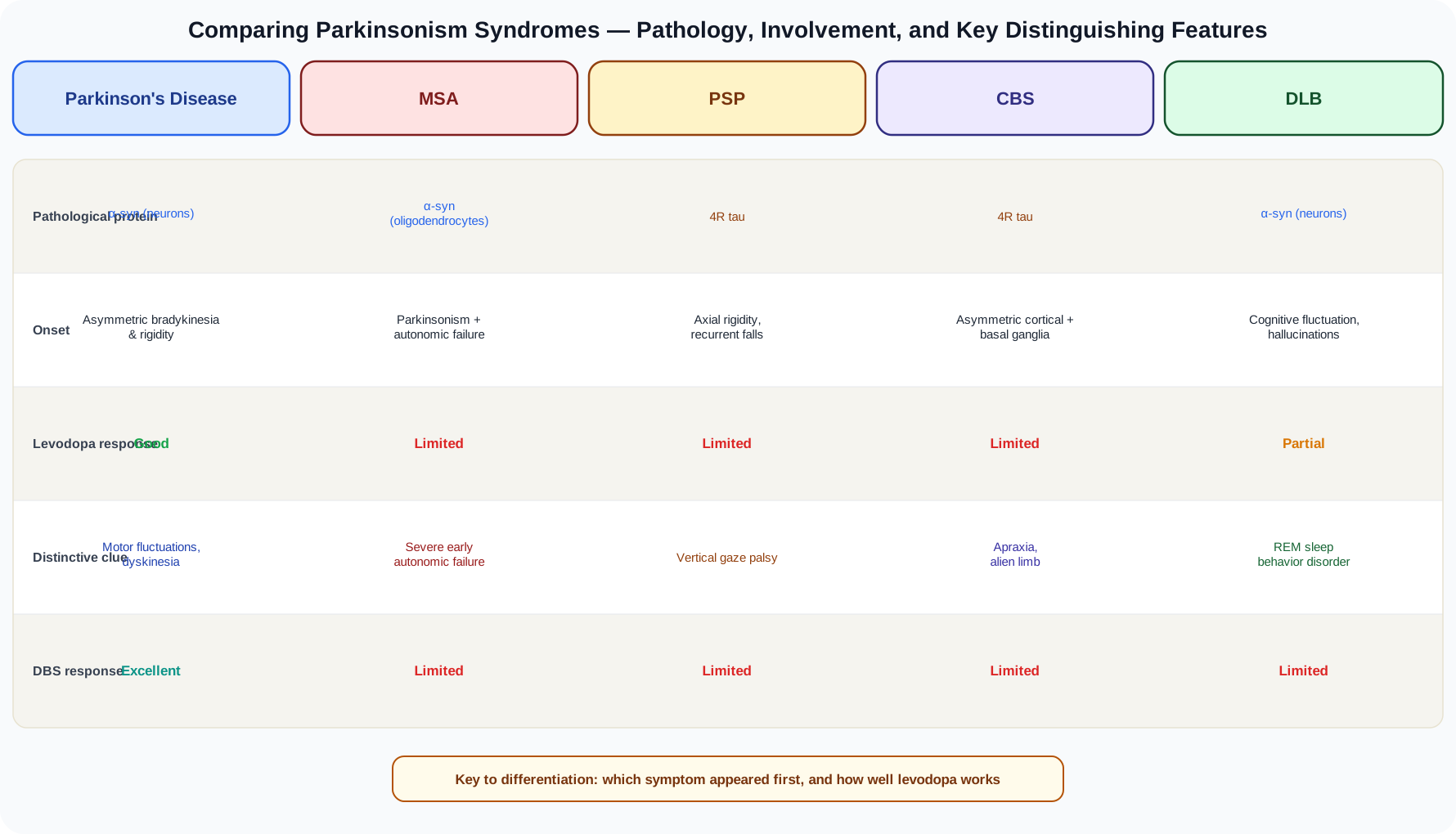
Figure. Parkinson’s disease, MSA, PSP, CBS, and DLB compared side by side. Timing and levodopa response are among the most useful clinical clues.
1. First, look at the levodopa response
One of the most important features of Parkinson’s disease is a relatively good response to levodopa.
Bradykinesia,
rigidity,
and some tremor
can improve clearly.
As the disease progresses,
wearing-off,
ON-OFF fluctuations,
and dyskinesia
may appear.
By contrast, levodopa response is generally more limited in MSA, PSP, and CBS.
Some patients may show an early response, but a clear and sustained response like that often seen in Parkinson’s disease is less common.
In DLB, parkinsonism may improve to some extent with levodopa, but medication adjustment can be more complicated because cognition and hallucinations also need to be considered.
So the first question is:
“How clearly does levodopa work, and how long does the benefit last?”
2. Second, look at how the disease began
Parkinson’s disease often begins asymmetrically.
One hand may become slow first,
one arm may lose its normal swing,
or one leg may become uncomfortable first.
CBS can also begin very asymmetrically.
But in CBS, the important point is that the asymmetric parkinsonism is accompanied by cortical signs such as
apraxia,
cortical sensory loss,
or alien limb phenomena.
PSP may bring axial symptoms and balance problems to the foreground relatively early.
MSA may bring autonomic dysfunction or cerebellar symptoms early alongside parkinsonism.
DLB may bring cognitive fluctuations and hallucinations into the picture very early together with motor symptoms.
3. Third, look for early falls
Falls can also occur in Parkinson’s disease as the disease progresses.
But recurrent falls very early in the course should raise concern for atypical parkinsonism.
Early falls are especially important in PSP.
A tendency to fall backward,
axial rigidity,
and early impairment of postural reflexes
may appear together.
So the combination
parkinsonism + early recurrent falls
is a strong clue toward PSP.
4. Fourth, look at the eyes
Eye movements are extremely important when distinguishing parkinsonian syndromes.
In PSP, vertical eye-movement impairment, especially difficulty looking downward, is characteristic.
Rapid downward saccades may become slow or restricted.
Eye-movement abnormalities can also occur in Parkinson’s disease, but clear vertical gaze impairment early in the disease is not typical.
So the simple question
“Can the eyes move up and down normally?”
can be surprisingly useful.
5. Fifth, look at the autonomic nervous system
Orthostatic hypotension,
urinary dysfunction,
sexual dysfunction,
and sweating abnormalities
can also occur in Parkinson’s disease.
But in MSA these problems may appear earlier and more severely.
In particular,
severe early orthostatic hypotension,
rapidly progressive urinary dysfunction,
or large post-void residual or urinary retention
along with parkinsonism should raise suspicion for MSA.
What matters more than the mere presence of autonomic symptoms is
how early and how severe they are.
6. Sixth, look for cerebellar signs
The main motor problem in Parkinson’s disease lies in the basal ganglia motor circuits.
In MSA-C, by contrast, cerebellar involvement can be prominent.
The gait may become wide-based,
the body may sway,
the hand may miss its target,
and speech may become slurred.
So if parkinsonism is accompanied by
clear cerebellar ataxia,
MSA-C becomes an important consideration.
Prominent cerebellar signs early in typical Parkinson’s disease are not expected.
7. Seventh, look for cortical signs
Cortical signs are especially important when considering CBS.
These may include
apraxia,
cortical sensory loss,
alien limb phenomena,
myoclonus,
and nonfluent language impairment.
In Parkinson’s disease, a hand may become slow.
In CBS,
the motor plan for how to use the hand itself can break down.
That difference is very important.
8. Eighth, look at the timing of cognition and hallucinations
In DLB,
cognitive fluctuations,
recurrent well-formed visual hallucinations,
and REM sleep behavior disorder
may appear relatively early.
Cognitive impairment and hallucinations can also appear later in Parkinson’s disease.
So the key is the time relationship.
If cognitive impairment appears before parkinsonism, at about the same time, or becomes clearly established within one year after motor symptoms begin,
DLB is considered clinically.
If Parkinson’s disease has been clearly established for years before dementia develops,
the diagnosis is generally Parkinson’s disease dementia, or PDD.
9. Comparing the pathological proteins makes the differences clearer
Pathologically, the contrast becomes even sharper.
Parkinson’s disease
The key protein is α-synuclein.
It accumulates mainly in neurons, forming Lewy bodies and Lewy neurites.
MSA
Here too, α-synuclein is central.
But it accumulates predominantly in oligodendrocytes, forming glial cytoplasmic inclusions.
PSP
The key pathology is 4-repeat tau.
A characteristic finding is the tufted astrocyte.
CBD
CBD is also a 4-repeat tauopathy.
Astrocytic plaques and ballooned neurons are more characteristic findings.
DLB
DLB returns to α-synuclein pathology.
Neuronal Lewy pathology can extend widely into limbic and cortical regions.
So disorders that all look like parkinsonism can differ completely in both pathological protein and the cell type affected.
10. A one-glance comparison
| Disorder | Main pathology | Early pattern | Levodopa response | Characteristic clue |
|---|---|---|---|---|
| Parkinson’s disease | α-synuclein, neurons | Asymmetric bradykinesia, rigidity, tremor | Usually good | Motor fluctuations, dyskinesia |
| MSA | α-synuclein, oligodendrocytes | Parkinsonism + autonomic or cerebellar symptoms | Limited | Severe early autonomic failure, cerebellar ataxia |
| PSP | 4R tau | Axial rigidity, early falls | Limited | Vertical eye-movement impairment |
| CBS | Often 4R tau | Markedly asymmetric parkinsonism | Limited | Apraxia, cortical sensory loss, alien limb |
| DLB | α-synuclein, neurons | Cognitive fluctuation + parkinsonism | Some response | Visual hallucinations, RBD, early cognitive impairment |
This table is not meant to establish a diagnosis.
It is more like a map showing the typical direction of each disorder.
Real patients can show overlapping features.
11. DBS also shows why the distinction matters
In Parkinson’s disease,
there are levodopa-responsive motor symptoms,
and substantial portions of the STN-GPi motor circuit remain functionally modifiable,
so DBS can be very helpful in appropriately selected patients.
In MSA, PSP, and CBS,
multiple structures and networks undergo broader degeneration.
Stimulating one nucleus is therefore unlikely to improve the full syndrome.
That is why DBS generally has a limited role in atypical parkinsonian syndromes.
This again shows an important principle.
DBS does not treat
anything that merely looks parkinsonian.
It treats
a specific circuit state that remains functionally modifiable.
12. In the end, time is the most important clue
The word that runs through this entire appendix is
time.
It is not enough to ask which symptoms are present.
We also need to know
when they began,
what appeared first,
how quickly the disease progressed,
and how it responded to medication.
For example,
falls can occur in many disorders.
But when they occur early, PSP moves higher on the list.
Autonomic symptoms can occur in several disorders.
But when they are very severe early, MSA becomes more likely.
Cognitive impairment can occur in several disorders.
But when it appears at nearly the same time as the motor syndrome, DLB becomes more likely.
The sequence of symptoms reveals something about the nature of the disease.
What would I ask when I see a patient with parkinsonism?
If I were evaluating a patient with parkinsonism, I would no longer ask only
“Do you have tremor?”
The following questions may be more important.
When did the slowness begin?
Did it begin on one side?
How much does levodopa improve the symptoms?
Were falls frequent from early on?
Is looking downward uncomfortable or difficult?
Did orthostatic dizziness or urinary dysfunction become severe early?
Are there cerebellar signs in addition to slowness?
Is there apraxia — difficulty knowing how to use one hand despite adequate strength?
When did hallucinations and cognitive changes begin?
Was REM sleep behavior disorder present?
If the answers to these questions are placed in chronological order,
the direction of the disease gradually becomes clearer.
Looking back at Parkinson’s disease after studying parkinsonian syndromes
When I began this appendix,
I thought that understanding parkinsonian syndromes would help me understand Parkinson’s disease more clearly.
It did.
MSA shows that autonomic symptoms can occur in Parkinson’s disease too,
but also why they are not usually the central feature early in typical Parkinson’s disease.
PSP shows why postural instability in Parkinson’s disease usually becomes prominent later.
CBS shows that bradykinesia in Parkinson’s disease is very different from cortical apraxia.
DLB shows that Parkinson’s disease ultimately does not remain confined to motor circuits alone.
By comparing these other disorders,
the shape of Parkinson’s disease itself becomes clearer.
In the end, the circuit matters more than the name
Parkinson’s disease,
MSA,
PSP,
CBS,
DLB.
The names are different.
But patients may initially describe similar things:
“I’m slow.”
“Walking is difficult.”
“My body is stiff.”
What creates the difference is
which protein accumulates,
which cell is affected first,
which circuit fails first,
and in what sequence those changes progress.
In the end, we return to neuroanatomy.
The disease names differ, but symptoms come from circuits.
Appendix 6 in one line
The key to distinguishing Parkinson’s disease from atypical parkinsonian syndromes is not one symptom, but the overall pattern over time — levodopa response, disease progression, and the sequence in which early falls, autonomic, ocular-motor, cerebellar, cortical, and cognitive features appear.