Part 3. The direct and indirect pathways — how the gates of movement open and close
When I first learned the basal ganglia’s direct and indirect pathways, what I hated most was the arrows.
There were too many arrows.
Trying to memorize whether something was excitatory or inhibitory, D1 or D2, GPe or GPi, I lost sight of the question that actually mattered.
So what does this circuit do in my body?
After living through Parkinson’s disease, I looked again, and the question turned out to be simple.
I want to walk. I know where I’m going. My legs have strength.
So why won’t the first step come?
Understanding the basal ganglia circuit turned out to be, in the end, a matter of following that one question.
Chapter 17. Movement is not simply switched on
It’s easy to assume that the moment we decide to move, a command goes straight to the muscles.
But in the actual brain, a great deal of selection happens before that.
Should I stand up? Should I stay seated? Should I move the right foot first, or the left? How big a stride should I take? Should I suppress other movements happening nearby?
The basal ganglia sit at the center of this selection process.
So I found it more natural to understand the basal ganglia not as a simple motor switch, but as
a selection system that lets the needed movement through, among many possible movements.
Chapter 18. First, look at the whole map
Before looking at the direct and indirect pathways, let’s lay out the structure once more.
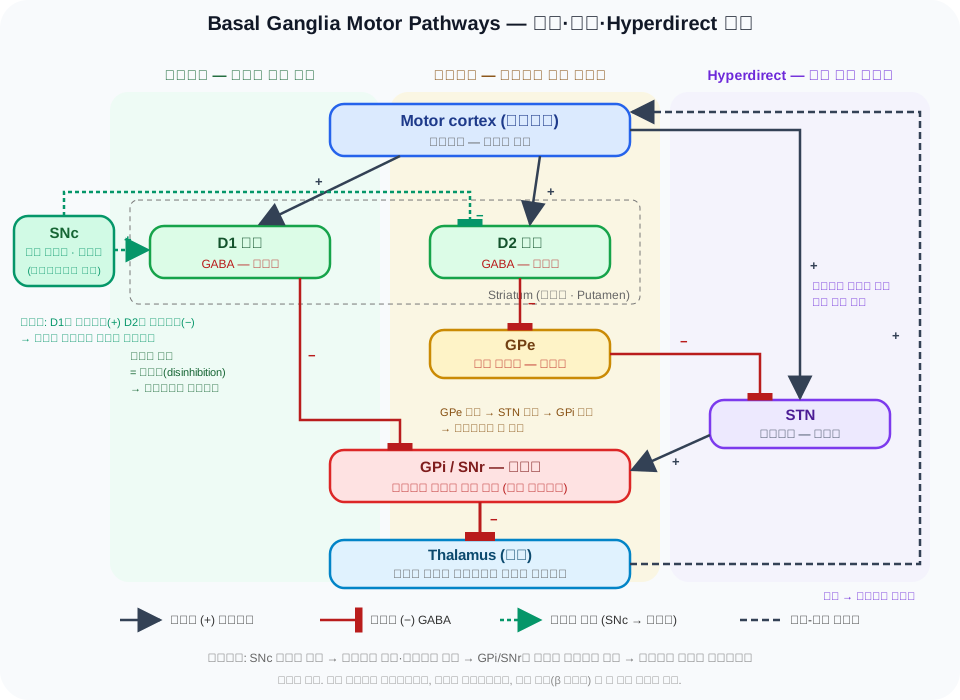
Signals from the cerebral cortex enter the striatum (especially the putamen), and from there the path splits.
Direct pathway
Cortex → Striatum(D1) → GPi/SNr → Thalamus → Motor cortex
The direction that makes it easier to open the gate for the needed movement.
Indirect pathway
Cortex → Striatum(D2) → GPe → STN → GPi/SNr → Thalamus → Motor cortex
The direction that contributes to suppressing competing movements.
And on top of these two pathways, dopamine signals from the substantia nigra pars compacta (SNc) act.
What each arrow in the figure means, we follow one by one below.
Chapter 19. GPi and SNr — the brake at the exit
One of the most important structures for understanding the basal ganglia is GPi and SNr.
These two are the basal ganglia’s main output nuclei. And even at baseline, they continuously inhibit the thalamus and some brainstem structures.
Put simply, the exit always has some degree of brake on. In the figure, this is the thick red bar running from GPi/SNr down to the thalamus.
Why is it set up this way?
The brain must not execute every possible movement at once. If sitting down suddenly while walking, turning in another direction while lifting a foot, and every unneeded movement all burst out together, movement would actually become impossible.
So it keeps inhibition on by default, and then
releases that inhibition appropriately only for the movement that is needed right now.
That is the efficient design.
Chapter 20. The direct pathway — opening the gate for the needed movement
In the direct pathway, D1-type neurons in the striatum play the key role.
An inhibitory signal goes from the striatum to GPi/SNr. But GPi/SNr itself is already inhibiting the thalamus.
In other words, it inhibits a structure that inhibits.
As a result, the inhibition on the thalamus is reduced. This is commonly called disinhibition.
It sounds complicated in words, but the actual meaning is simple. It briefly releases the brake. This is the green segment on the left of the figure.
When the thalamus becomes relatively free, the signal returning to the motor cortex strengthens, and the selected movement becomes easier to execute.
Chapter 21. The indirect pathway — suppressing competing movements
With only the direct pathway, the needed movement could be opened. But other movements must not burst out along with it.
The indirect pathway takes part in that role.
D2-type neurons in the striatum inhibit GPe. This can relatively activate the STN, which GPe normally inhibits. The STN acts to excite GPi/SNr. As a result, inhibition on the thalamus strengthens.
In the yellow segment at the center of the figure, two inhibitory (−) steps followed by one excitatory (+) step is exactly this sequence.
So the indirect pathway is better understood not simply as a circuit that stops the whole body, but as
a system that contributes to suppressing motor programs that are not needed.
Chapter 22. Is D1 the accelerator and D2 the brake?
Textbooks often explain it this way.
D1 = promotes movement. D2 = suppresses movement.
It’s convenient for a first pass. But the real circuit is not that simple.
The direct and indirect pathways are not two independent switches that flip on and off separately. In normal movement, the two pathways work together. They open the door for the needed action and suppress other actions that compete with it.
So a better way to put it is
the D1 pathway helps the selected action pass through, and the D2 pathway contributes to clearing away competing actions
— that is roughly how I think of it.
Chapter 23. Where does dopamine come in?
The key structure that supplies dopamine to this circuit is the substantia nigra pars compacta, SNc.
Dopamine fibers from the SNc project to the striatum, where they regulate D1-type and D2-type neurons in different ways.
The classical model describes dopamine as promoting activity in the D1 direct pathway while relatively reducing the influence of the D2 indirect pathway. That’s why the green dotted line in the figure enters D1 as an arrow (+) and D2 as a bar (−).
Overall, it creates conditions in which the needed movement can be more easily selected and executed.
So dopamine is not simply a “substance that makes the body move.”
It is closer to a signal that tunes the basal ganglia circuit to select the appropriate movement.
Chapter 24. What changes in Parkinson’s disease
In Parkinson’s disease, dopamine neurons in the SNc decrease. As a result, dopamine regulation in the striatum weakens.
By the classical basal ganglia model, the movement-promoting effect through the direct pathway weakens while the suppressive effect through the indirect pathway relatively strengthens, and the balance shifts in that direction.
As a result, the output of GPi/SNr can tilt toward over-inhibiting the thalamus. Then the motor cortex has a harder time initiating and sustaining movement.
In my body, this did not feel like simple muscle weakness.
I have the strength, but the movement does not come out.
That difference mattered.
Chapter 25. But this alone cannot explain all of Parkinson’s disease
Here there is one important caveat.
The direct/indirect pathway model is very useful. But current basal ganglia research does not explain Parkinson’s disease simply as direct pathway ↓ / indirect pathway ↑.
Not only how much neurons fire, but the pattern in which they fire, also matters.
In particular, abnormal synchronization and increased beta-band activity in the basal ganglia–thalamo–cortical circuit are being studied in relation to the motor symptoms of Parkinson’s disease.
In other words, the problem is not simply that the signal is too strong or too weak. The whole circuit becoming excessively locked into the same rhythm can also reduce the flexibility of movement.
Chapter 26. The hyperdirect pathway — a very fast brake
Beyond the direct and indirect pathways, there is one more important route.
The hyperdirect pathway. It runs from the cerebral cortex straight to the STN without passing through the striatum.
Cortex → STN → GPi/SNr
This pathway can very rapidly take part in suppressing the entire motor output. This is the purple segment on the right of the figure. Because it skips the striatum, it is the shortest of the three pathways.
Put simply, while the direct pathway opens the selected gate and the indirect pathway closes the gates of its competitors, the hyperdirect pathway can be understood as something like a fast braking system that says,
“Wait — stop everything for now.”
But this, too, is just a simplified analogy. Real movement selection and suppression arise from the three pathways interacting with one another.
Chapter 27. Why is the first step especially hard?
I can stand still. My legs have strength. But when I try to take a step forward, my body stops.
This makes a little more sense when I think about the basal ganglia’s selection function.
Starting to walk is not simply contracting the leg muscles. I have to end the current posture, shift my weight to one side, lift the other foot, and move forward while regaining balance.
In other words, several motor programs have to switch within a very short moment.
The basal ganglia take part in this kind of motor selection and switching. So when the internal signal that initiates movement weakens, the first step can become especially difficult.
Chapter 28. Why does the foot suddenly come out once the medication takes effect?
When levodopa starts to take effect, I often notice a very small change first.
My body loosens up a little. The resistance to moving my foot decreases. And at some moment, walking suddenly becomes natural.
It’s not that muscle strength suddenly appeared at that moment. As dopamine changes the operating state of the circuit,
the conditions for selecting and executing the needed motor program are re-created
— that is how I understand it.
So the difference between ON and OFF is not simply a difference in strength. It is also a difference in how easily a motor program can be drawn out.
Chapter 29. How to remember the direct and indirect pathways without memorizing them
I no longer memorize this circuit as arrows. I remember it in three sentences.
- At the basal ganglia’s exit, a brake is on by default.
- For the needed movement, the brake is released.
- For competing movements, the brake is maintained or applied harder.
Dopamine tunes this selection so that it happens naturally. In Parkinson’s disease, that tuning is disrupted. Then selecting, starting, sizing, and switching movement can all become difficult.
Closing Part 3
When I first learned the basal ganglia’s direct and indirect pathways, I memorized the arrows.
But after living it in my own body, I saw that what mattered was not the direction of the arrows.
Why, even when I want to move, can’t I bring the movement out?
That was the question.
The basal ganglia are not the final motor neurons that command muscles directly. What to do. What not to do. When to start. How large to move. They are a circuit that continuously adjusts those choices.
So understanding movement in Parkinson’s disease takes more than looking at muscle strength or the amount of dopamine alone. We have to see which circuit dopamine is acting on, and which choice it is changing.
And one question remains.
If the basal ganglia are the system that selects movement, why, at certain moments, do the feet truly refuse to move, as if stuck to the floor?
In Part 4, I want to follow that question.
This article is for education, to help understand movement in Parkinson’s disease. Any change to an individual’s medication type, dose, or timing should be discussed with the treating clinician.