Appendix 5. Dementia with Lewy Bodies (DLB)
— The same α-synuclein, so why do cognition and perception falter first?
Parkinson’s disease and dementia with Lewy bodies share an important biological feature: α-synuclein pathology.
Both can show Lewy bodies. Both can produce parkinsonism.
Yet the clinical pictures are not identical.
In Parkinson’s disease, bradykinesia, rigidity, and tremor often dominate first.
In dementia with Lewy bodies (DLB), cognitive change, marked fluctuations in attention, well-formed visual hallucinations, and REM sleep behavior disorder may become prominent early.
That raises a question:
If the same protein is involved, why does one disorder present first with movement while the other brings cognition and perception to the foreground?
The answer again lies in where the pathology is distributed and how widely it spreads.
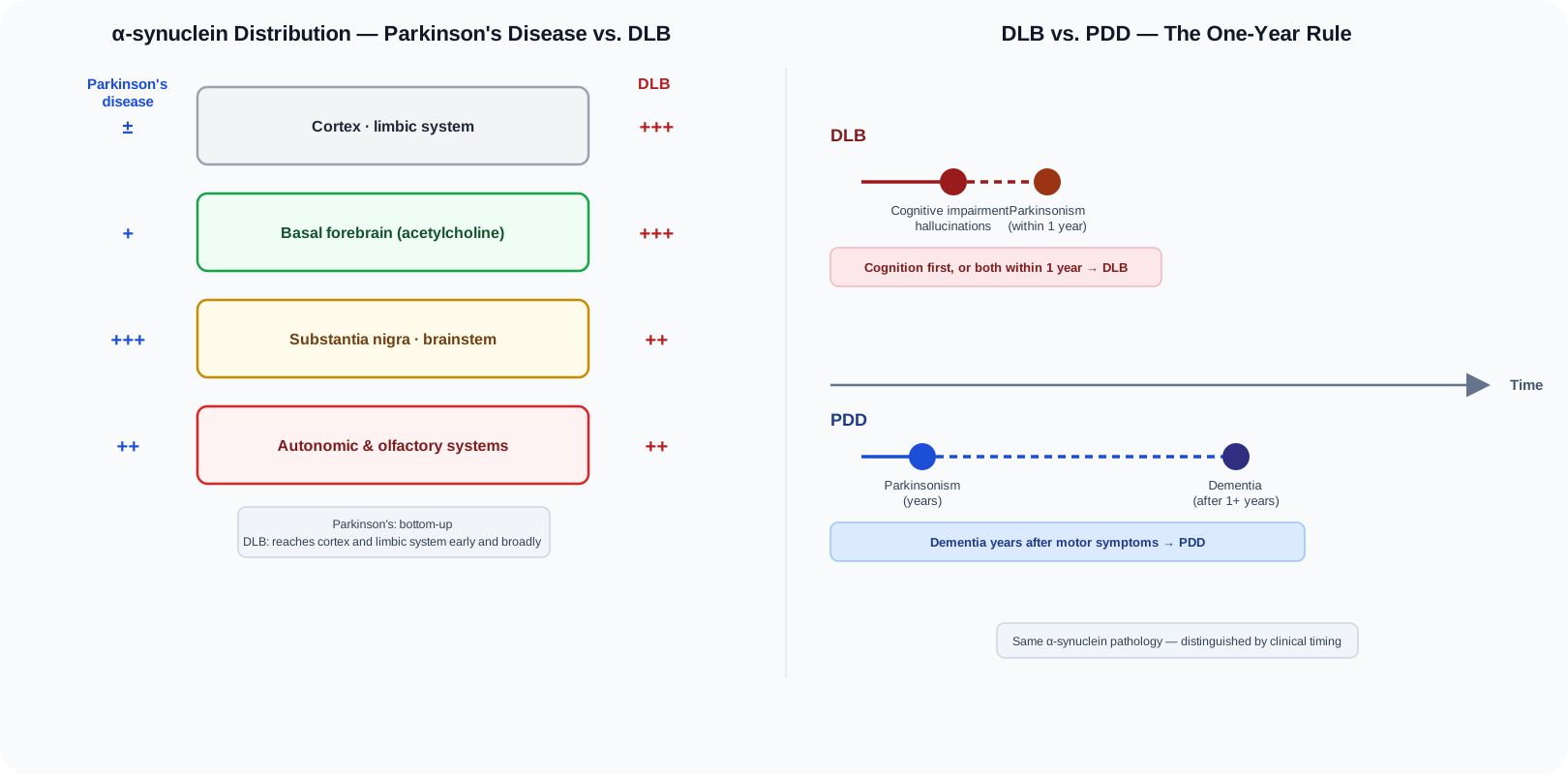
Figure. Parkinson’s disease and DLB share neuronal α-synuclein pathology, but the distribution and clinical timing differ. The DLB/PDD distinction is based largely on the temporal relationship between dementia and parkinsonism.
1. What is DLB?
DLB stands for Dementia with Lewy Bodies.
It is one of the major neurodegenerative causes of dementia.
Its clinical pattern, however, can differ from Alzheimer disease.
Rather than only showing a gradual decline in memory, DLB often includes large changes in attention and alertness, visual hallucinations, and parkinsonian motor features.
Families may say, “Yesterday he seemed fine, but today he is completely different.”
That fluctuation is an important clue.
2. Cognition can change within the same day
In Alzheimer disease, progressive memory loss is often the dominant early picture.
DLB can look different.
At one time, a person may converse well and understand the situation accurately.
A few hours later, that same person may become blank, inattentive, or unable to answer questions appropriately.
Then later, the person may improve again.
This can be difficult to explain as simple fatigue alone.
In DLB, the neural networks that sustain attention and arousal may themselves become unstable.
3. Why are visual hallucinations so characteristic?
One of the most important features of DLB is recurrent, well-formed visual hallucinations.
These may be more than vague shadows.
People may see children, animals, or clearly formed human figures.
The experience can feel very real.
Some patients retain partial insight that what they are seeing is unusual, while others accept it fully as reality.
Why does this happen?
4. Seeing is not only the work of the eyes
We often say that we see with our eyes, but the experience of seeing is constructed by the brain.
Signals from the retina reach visual cortex in the occipital lobe.
Then wider cortical networks determine what an object is, where it is, whether a face is familiar, and whether something is threatening.
Attention and arousal systems also help the brain decide whether incoming information reflects a real external event.
In DLB, visual-processing and attention networks can become unstable together.
As a result, the brain may misinterpret incomplete visual information or treat internally generated imagery as an external object.
Visual hallucinations are therefore not simply an eye problem; they are a network-level disorder of perception.
5. Why REM sleep behavior disorder matters
REM sleep behavior disorder (RBD) is commonly associated with DLB.
During normal REM sleep, most skeletal muscles are strongly inhibited, so dream actions are not carried out by the body.
When that inhibition fails, dream content may be enacted physically.
A person may shout, punch, kick, or even fall from bed.
An important point is that RBD can begin long before dementia or parkinsonism becomes apparent.
This suggests that α-synuclein pathology can affect brainstem sleep-regulation circuits before motor cortex becomes clinically dominant.
6. Parkinsonian motor symptoms also occur
DLB can produce bradykinesia, rigidity, gait impairment, and postural instability.
It is therefore an important disorder in the differential diagnosis of parkinsonism.
Compared with typical Parkinson’s disease, rest tremor may be less prominent, and bilateral or axial features may appear relatively early in some patients.
Levodopa can help, but the response may be less dramatic than in typical Parkinson’s disease.
Clinicians must also consider that increasing dopaminergic therapy may worsen hallucinations or confusion in some patients.
7. The most confusing question — are DLB and Parkinson’s disease dementia different diseases?
Patients with longstanding Parkinson’s disease can also develop dementia.
This is called Parkinson’s disease dementia (PDD).
Yet DLB and PDD overlap substantially in pathology.
Both are strongly linked to α-synuclein and Lewy body pathology.
So how are they separated clinically?
The practical answer is mainly timing.
8. The one-year rule
Traditionally, the one-year rule has been used to distinguish DLB from PDD.
If dementia appears before parkinsonism, at roughly the same time, or within one year after the onset of parkinsonian motor symptoms, the clinical diagnosis favors DLB.
If Parkinson’s disease has been clearly established for years before dementia develops, the diagnosis is PDD.
This rule does not mean the underlying biology becomes completely different at 12 months.
Rather, it is a practical clinical convention used to separate two disorders that may lie along a closely related biological continuum.
9. The core pathology is again α-synuclein
DLB is a classic synucleinopathy.
α-synuclein accumulates abnormally within neurons, forming Lewy bodies and Lewy neurites.
The same pathology can occur in Parkinson’s disease.
The major difference is distribution.
In typical motor-first Parkinson’s disease, pathology in the substantia nigra and brainstem plays a major role in producing the early motor syndrome.
In DLB, pathology is often already widespread into limbic structures and neocortex.
That broader distribution can bring cognition, attention, perception, and behavior to the foreground earlier.
10. The same protein, a different distribution
This principle has appeared repeatedly throughout these appendices.
MSA and Parkinson’s disease are both related to α-synuclein, but in MSA the defining pathology is mainly in oligodendrocytes.
In Parkinson’s disease and DLB, neuronal Lewy pathology is more central.
Even between Parkinson’s disease and DLB, however, distribution and degree of involvement differ.
So disease is not determined only by which protein is abnormal.
It also matters which cells contain it, which brain regions are affected first, and how widely it spreads.
11. Acetylcholine matters too
DLB is not only a dopamine disorder.
Changes in the cholinergic system are especially important for cognition and attention.
Basal forebrain cholinergic networks contribute to attention, memory, and information processing.
When these systems are damaged, attention and cognition can become unstable.
That is one reason cholinesterase inhibitors are used in some patients to help manage cognitive and behavioral symptoms.
This is another reminder that DLB cannot be understood as a simple dopamine deficiency state.
12. Autonomic symptoms are common
Orthostatic hypotension, constipation, urinary dysfunction, and sweating abnormalities can also occur in DLB.
These features overlap with other synucleinopathies such as Parkinson’s disease and MSA.
But the pattern is not identical to MSA, where severe autonomic failure may become a dominant feature very early.
Again, what matters is not only whether a symptom is present, but when it began and how severe it is.
13. Why can antipsychotic sensitivity be a problem?
One of the most important clinical concerns in DLB is marked sensitivity to antipsychotic medications.
If hallucinations or delusions are treated with a drug that strongly blocks dopamine receptors, rigidity and bradykinesia can worsen dramatically, and alertness or general medical status may deteriorate.
For that reason, treatment of behavioral and psychiatric symptoms in DLB requires particular caution.
The motor dopamine system is already vulnerable, so suppressing dopamine signaling further can worsen the movement disorder even if hallucinations improve.
14. Hallucinations alone do not mean DLB
This point is essential.
Visual hallucinations can also occur in Parkinson’s disease.
They can be related to medication, infection, sleep deprivation, delirium, cognitive decline, or other causes.
So hallucinations alone are not enough to diagnose DLB.
The full pattern matters: cognitive fluctuations, recurrent well-formed hallucinations, RBD, parkinsonism, autonomic symptoms, and the timing of these features.
15. Alzheimer pathology can coexist
Another important feature of DLB is mixed pathology.
Some patients have not only α-synuclein pathology but also Alzheimer-type pathology involving amyloid-β and tau.
This can influence the clinical presentation and rate of progression.
Real neurodegenerative disease in older adults is not always pathologically pure.
Multiple degenerative processes can coexist in the same brain.
16. What can imaging and other tests contribute?
MRI is mainly useful for excluding other structural disease and assessing patterns of atrophy.
DLB cannot be diagnosed by MRI alone.
Depending on the situation, dopaminergic imaging, tests of cardiac sympathetic function, or sleep studies can provide supportive information.
But the clinical pattern remains central.
When did cognitive fluctuations and hallucinations begin?
How are they related in time to parkinsonism?
Is REM sleep behavior disorder present?
The sequence of events matters.
17. DLB shows why temporal sequence is so important
DLB and PDD may be very close pathologically.
Yet clinically, the label depends on the order in which motor and cognitive symptoms appear.
This connects with something I have repeatedly found important while studying Parkinson’s disease.
In neurology, what appeared first can matter as much as what is present now.
The same hallucination means something different if it appears before motor symptoms, at the same time, or after ten years of established Parkinson’s disease.
DLB and Parkinson’s disease through the lens of pathology
Parkinson’s disease and DLB are not distant disorders.
Both are synucleinopathies in which α-synuclein accumulates within neurons.
Both can show Lewy body pathology.
Both can produce motor and nonmotor symptoms.
In Parkinson’s disease, early nigrostriatal involvement often brings the motor syndrome to the foreground.
In DLB, cortical, limbic, attention, and perceptual networks can become involved earlier, bringing cognitive fluctuations, hallucinations, and behavioral change to the foreground.
The same pathological protein can therefore produce different clinical pictures depending on how far the disease has spread.
Understanding DLB makes Parkinson’s disease easier to see
Comparing DLB with Parkinson’s disease changes how Parkinson’s disease itself looks.
Parkinson’s disease often begins with movement, but it is never confined to the motor circuit forever.
As pathology spreads into broader neural networks, cognition, sleep, perception, and autonomic function can also become affected.
DLB makes that principle especially clear.
And when DLB is compared with Parkinson’s disease dementia, the same question keeps returning:
In which circuit did α-synuclein pathology begin, and in what sequence did it spread?
That sequence helps shape the sequence of symptoms.
Appendix 5 in one line: DLB is a neuronal α-synucleinopathy in which early involvement of cortical, limbic, attention, and perceptual networks can produce cognitive fluctuations, recurrent visual hallucinations, REM sleep behavior disorder, and parkinsonism; the timing of cognitive and motor symptoms is central to the clinical distinction from Parkinson’s disease dementia.