Appendix 3. Progressive Supranuclear Palsy (PSP)
— Why do the eyes and posture fail first?
Among the parkinsonian syndromes, progressive supranuclear palsy, or PSP, shares some features with Parkinson’s disease but often begins to look different relatively early.
Its full name is Progressive Supranuclear Palsy.
The name itself contains several important clues.
Progressive means that the disorder advances over time.
Supranuclear means that the higher control circuits above the cranial nerve nuclei that move the eyes are predominantly affected.
Palsy refers to impaired control of movement.
The terminology sounds difficult at first, but the core picture is fairly clear.
In PSP, the central axis of the body can become rigid, balance can fail early, and the ability to move the eyes — especially vertically — can become impaired.
So although patients may become slow and rigid like those with Parkinson’s disease, posture and eye-movement problems often come to the foreground more than tremor.
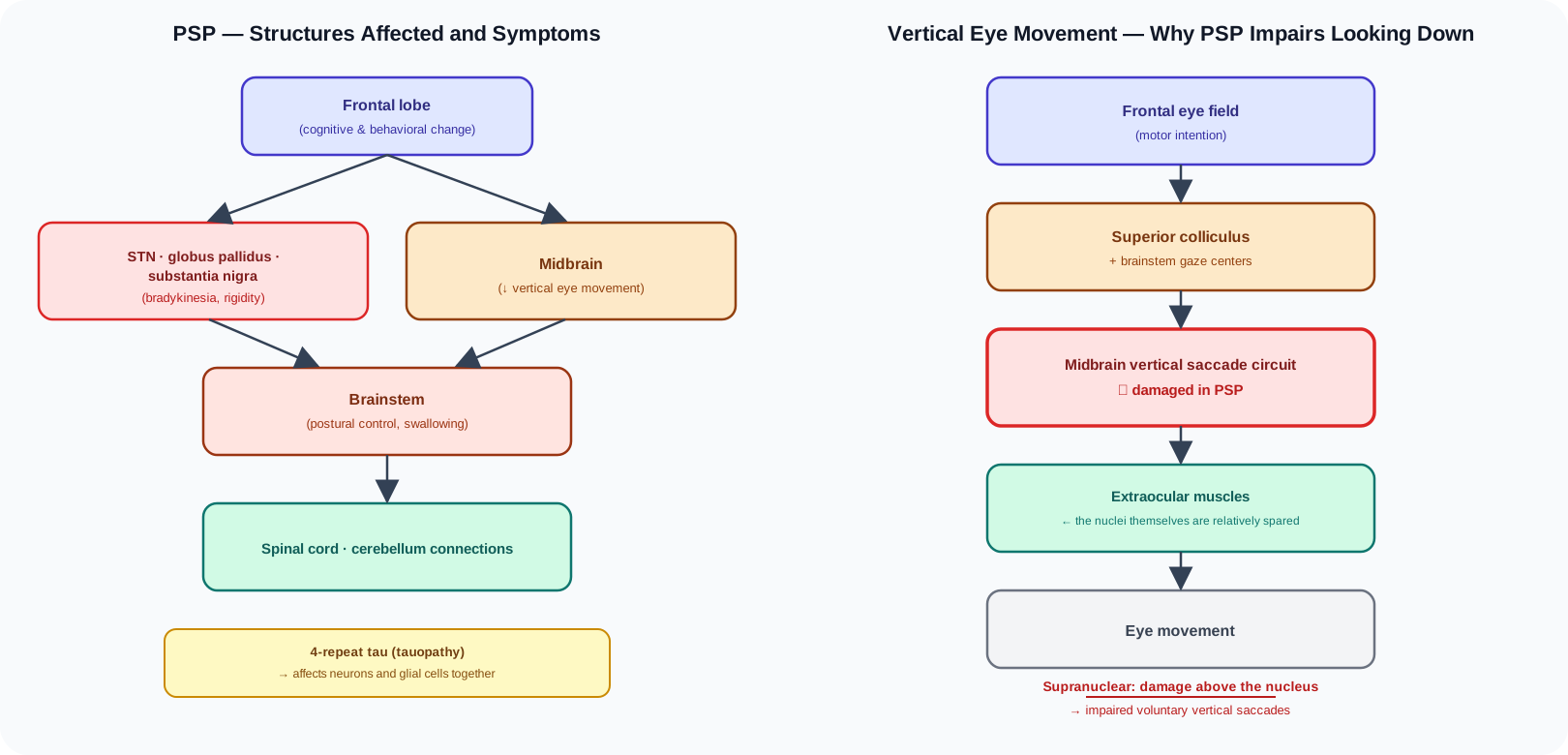
Figure. PSP can affect the midbrain, STN, globus pallidus, substantia nigra, brainstem, and frontal networks.
1. PSP is also a parkinsonian syndrome
Patients with PSP can show bradykinesia, rigidity, gait impairment, and postural instability.
That is why early PSP can initially be mistaken for Parkinson’s disease.
As time passes, however, clues that are less typical of Parkinson’s disease become more apparent.
Important examples include early recurrent falls, vertical eye-movement impairment, stiffness of the neck and trunk, speech and swallowing difficulty, and cognitive or behavioral change.
2. Why do falls happen early?
In typical Parkinson’s disease, marked postural instability and recurrent falls usually become more prominent after the disease has progressed for some time.
In PSP, falls can appear relatively early, often with a tendency to fall backward.
This is not simply because the legs are weak. Brainstem and postural-control circuits that maintain balance and respond to sudden shifts in posture can be affected.
So falls in PSP are better understood as a problem of postural reflexes and axial motor-control networks, not simple muscle weakness.
3. Why are the trunk and neck so rigid?
In Parkinson’s disease, rigidity of the arms or legs may be especially obvious.
In PSP, rigidity of the axial region — the neck and trunk — can be more prominent.
The neck stiffens, turning the trunk becomes difficult, and changing posture is harder.
This axial rigidity worsens gait and balance.
The patient may feel not merely slow, but as if the whole body moves as a single rigid block.
4. The most characteristic clue — vertical eye-movement impairment
The best-known feature of PSP is impairment of vertical eye movements.
Looking downward can become particularly difficult.
That matters because we look down constantly while walking and eating — at stairs, thresholds, floor obstacles, shoes, and a plate of food.
When downward gaze becomes impaired, stairs become less secure, eating becomes more awkward, and obstacles on the floor are harder to avoid.
Eye-movement dysfunction can therefore directly increase the risk of falls.
5. Why is it called supranuclear palsy?
The eye muscles themselves are not primarily paralyzed, and the cranial nerve nuclei that move the eyes are not necessarily the first structures to fail completely.
The problem lies in the higher control circuits above them.
Voluntary rapid eye movements, or saccades, depend on these higher networks.
A patient may have difficulty voluntarily looking downward while certain reflexive eye movements remain relatively better preserved.
That distinction is why the term supranuclear is used.
6. Eye movement is also a motor circuit
Moving the eyes is the result of a neural network just as complex as moving the arms and legs.
The frontal eye fields, superior colliculus, brainstem ocular-motor centers, basal ganglia, and cerebellum all participate.
In PSP, involvement of the midbrain and brainstem disrupts this network.
This helps move us beyond the idea that parkinsonian disorders are diseases only of the arms and legs.
Eye movement is also part of the brain’s motor network.
7. The pathological core is tau, not α-synuclein
Here PSP differs fundamentally from MSA.
In MSA, α-synuclein is central to the pathology.
In PSP, the key protein is tau, so PSP belongs to the tauopathies.
Tau normally helps stabilize microtubules inside neurons. Microtubules are important for intracellular transport and structural support.
When tau becomes abnormally modified and aggregated, it can lose its normal function and accumulate as pathological deposits.
8. What kind of tau pathology occurs in PSP?
PSP is a classic 4-repeat tauopathy.
That means tau isoforms containing four repeat domains are predominantly involved.
Pathology can occur not only in neurons but also in astrocytes and oligodendrocytes.
One characteristic finding is the tufted astrocyte, in which tau accumulates in astrocytes in a distinctive pattern.
This is one of the classic pathological features of PSP.
9. Which regions are mainly affected?
Several brain regions can be involved in PSP.
Important areas include the midbrain, subthalamic nucleus (STN), globus pallidus, substantia nigra, and multiple brainstem nuclei.
Midbrain and brainstem involvement contributes to eye-movement, posture, gait, and swallowing problems.
Basal ganglia involvement contributes to parkinsonian bradykinesia and rigidity.
PSP is therefore easier to understand when both the basal ganglia and the brainstem are considered together.
10. If the STN is affected, why does parkinsonism occur?
The subthalamic nucleus (STN) can also be pathologically involved in PSP.
This is the same structure encountered in the DBS chapter.
The STN plays an important role in inhibitory basal ganglia networks and movement selection.
Degeneration of this region and its surrounding circuits can further disturb motor-network balance and contribute to bradykinesia, rigidity, and axial symptoms.
But because PSP is not simply a dopamine-deficiency disorder like typical Parkinson’s disease, levodopa responsiveness is often limited.
11. Why is the levodopa response often weak?
In Parkinson’s disease, even as nigral dopamine neurons are lost, the striatum and downstream circuitry can remain relatively functional for a considerable period.
That allows levodopa replacement to produce a strong response.
In PSP, not only the substantia nigra but also the STN, pallidum, brainstem, and frontal-connected networks can be affected.
Replacing dopamine alone therefore cannot correct the entire problem.
Even when some levodopa response is present, it is often less dramatic or less sustained than in typical Parkinson’s disease.
12. Why is tremor often less prominent?
Rest tremor can be a major symptom in typical Parkinson’s disease.
In PSP, tremor is often not the dominant feature.
Instead, axial rigidity, gait dysfunction, postural instability, and eye-movement impairment may stand out more strongly.
This difference can be understood as a difference in which neural networks are most heavily affected.
In PSP, widespread degeneration of brainstem and postural-control systems is often more important than a simple nigrostriatal dopamine deficit.
13. Speech and swallowing can be affected early
Speech in PSP can become slow and unclear.
The voice may change, and the rhythm of speech may become abnormal.
Swallowing difficulty can also appear relatively early.
This is not simply because the muscles of the mouth and pharynx are weak. Brainstem and corticobulbar networks that coordinate the complex sequence of speaking and swallowing can be affected.
As dysphagia worsens, the risk of aspiration rises.
That makes swallowing, nutrition, and aspiration prevention important clinical goals in PSP.
14. Cognitive and behavioral changes also matter
PSP can affect functions associated with the frontal lobes.
Examples include apathy, slowing of behavior, executive dysfunction, difficulty shifting attention, and changes in social judgment.
This is not simply a matter of losing motivation because the disease is severe.
The circuits connecting the frontal lobes and basal ganglia can themselves be affected.
PSP is therefore both a movement disorder and a frontal-basal ganglia network disorder.
15. What can imaging show?
MRI can show findings that support PSP.
Midbrain atrophy is one of the best-known features.
On sagittal MRI, the atrophic midbrain can produce the hummingbird sign or penguin sign.
On axial images, the altered midbrain contour has also been described as the morning glory sign.
These findings may be subtle or absent early, however.
Imaging should therefore be interpreted together with the clinical pattern rather than used as a stand-alone diagnosis.
16. PSP does not have only one clinical face
PSP was once thought of mainly as one classic syndrome.
We now recognize several clinical phenotypes.
The classic form is PSP-Richardson syndrome, characterized by early falls, vertical eye-movement impairment, axial rigidity, and cognitive-behavioral change.
Some patients, however, initially look much more like Parkinson’s disease. This form is often called PSP-parkinsonism.
In such patients, asymmetry and some levodopa responsiveness may be present early, making the distinction from Parkinson’s disease more difficult.
17. Why is DBS generally not a good option?
PSP affects not only basal ganglia structures such as the STN and GPi but also the brainstem, ocular-motor circuits, postural-control systems, and frontal networks.
Modulating one key motor node therefore cannot correct the entire disorder in the way it sometimes can in Parkinson’s disease.
Levodopa responsiveness is also often limited.
For these reasons, typical PSP is generally not considered a good indication for DBS.
This again illustrates that DBS treats reversible dysfunction in particular circuits, not parkinsonism as a symptom label by itself.
Looking at PSP through pathology
In MSA, α-synuclein accumulates predominantly in oligodendrocytes.
In PSP, tau accumulates in neurons and glial cells.
So although both disorders can look slow, rigid, and parkinsonian from the outside, the underlying pathological protein is different from the beginning.
MSA is a synucleinopathy; PSP is a tauopathy.
Those pathological differences help determine which cells and circuits fail first and which symptoms move to the foreground.
Understanding PSP makes Parkinson’s disease easier to see
Compared with PSP, the characteristic features of Parkinson’s disease become clearer.
Parkinson’s disease often begins asymmetrically and responds relatively well to levodopa.
Marked early falls and vertical eye-movement impairment are not typical early features.
In PSP, early falls, axial rigidity, vertical ocular-motor dysfunction, and earlier gait or swallowing problems may be more prominent.
So even when two disorders share “parkinsonian symptoms,” which symptom appears first and in what sequence the disease unfolds can be crucial for distinguishing them.
Appendix 3 in one line
Progressive supranuclear palsy (PSP) is a 4-repeat tauopathy in which tau accumulates in neurons and glial cells across the midbrain, basal ganglia, brainstem, and frontal networks, so parkinsonian bradykinesia and rigidity can occur together with early falls, axial rigidity, and vertical eye-movement impairment.