Part 5. Does the Cerebellum Create Movement, or Refine It?
— Not where movement begins, but where it is constantly corrected
When you first learn about the cerebellum, the phrase that usually comes up first is this.
Balance and motor coordination.
Not wrong. But too short.
The cerebellum is not simply an organ that keeps us from falling over. While we reach out a hand, walk, turn the body, pick up a cup, or climb stairs, the cerebellum is continuously doing one thing.
“Is the movement I intended the same as the movement that actually came out?”
The cerebellum compares that difference and corrects it. That is why I find it easier to understand the cerebellum not as the conductor of movement but as movement’s error-corrector.
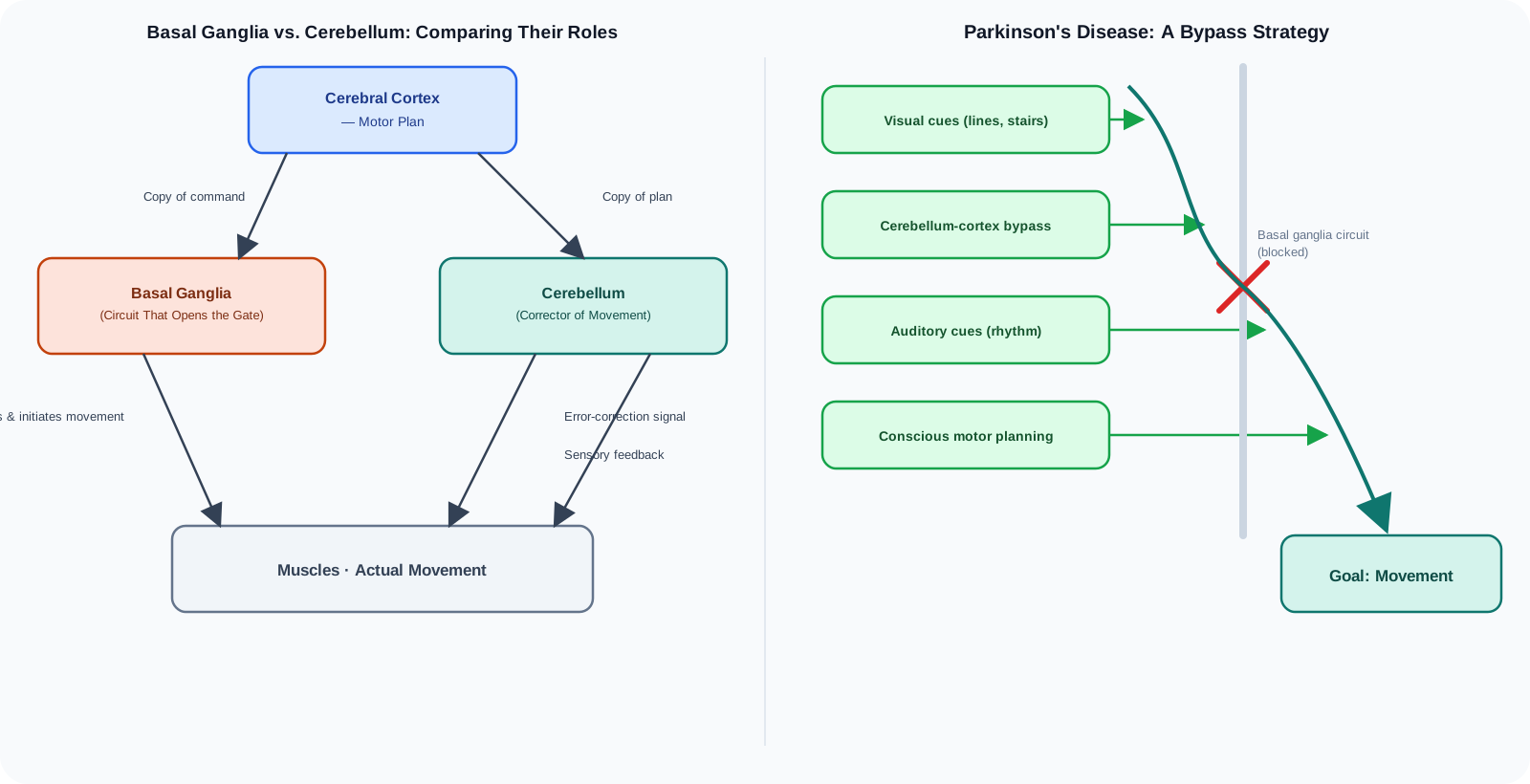
Figure 1. Comparison of the roles of the basal ganglia (the circuit that opens the door) and the cerebellum (movement’s error-corrector), and the bypass strategy in Parkinson’s disease
1. Where commands are issued and where they are corrected are different places
Suppose you think about raising your arm. The plan for the movement is made in the cerebral cortex. The motor cortex sends the command down to the spinal cord. The muscles receive that command and actually contract.
So what does the cerebellum do?
Two kinds of information arrive at the cerebellum almost simultaneously.
One is a copy of the motor plan — “I intend to move like this.”
The other is sensory information — “The body is actually moving like this right now.”
The cerebellum compares the two. When a difference arises between the intended movement and the actual movement, it calculates that difference and corrects it.
So when the cerebellum is damaged, muscle strength does not disappear entirely. The strength is there, but the movement overshoots the target, the motion becomes unsteady, and speed and distance cannot be matched precisely. The cerebellum is not so much an organ that directly creates movement as an organ that makes an already-created movement precise.
2. The cerebellum calculates error
One of the most important words for understanding cerebellar function is error correction.
Say you reach out your hand to pick up a cup on the table. The cerebral cortex sees the position of the cup and forms a plan to move the hand. But the actual movement always produces a small error.
The cerebellum calculates this error quickly. And in the next instant it corrects the motor command. So a normal motion does not end with a single command.
Plan → execute → compare → correct → execute again
This process repeats very rapidly. Even in the moment we feel as a single smooth motion, countless corrections are continuously occurring in the brain.
3. The basal ganglia and the cerebellum regulate movement in different ways
When you study Parkinson’s disease, the basal ganglia occupy almost the entire conversation. Along the way, the cerebellum can start to feel as if it has little to do with Parkinson’s disease. But actual movement is not that simple.
The basal ganglia and the cerebellum are both connected to the motor cortex, but their roles differ.
The basal ganglia are mainly involved in which movement to select, and how easily to start it.
The cerebellum is involved in whether that movement is being carried out as planned, and how precisely to correct it.
Put very simply, you could think of the basal ganglia as the circuit that opens the door, and the cerebellum as the circuit that refines the movement passing through the open door.
4. In Parkinson’s disease, the cerebellum becomes more important
In Parkinson’s disease, the basal ganglia circuit does not function normally. Movements that should occur automatically become especially difficult.
What is interesting is that, at such times, other circuits can take over some of that function. A representative example is the compensatory circuit that uses the cerebellum and the cerebral cortex.
I feel this often in my own body.
Normally the first step does not come easily, but if a line is drawn on the floor, I can cross that line. If someone sets a rhythm, my feet move. On stairs, walking can even be easier than on flat ground.
Ordinary automatic gait relies heavily on the basal ganglia. But the act of crossing a line right in front of me, or stepping onto a stair, relies more on external visual information and conscious motor planning. At such moments the cerebellum-cortex circuit may be recruited relatively more actively.
5. Cueing creates a bypass
The cueing used in Parkinson’s disease is not a simple trick.
There are patients whose movement suddenly becomes easier when they match a beat — “one, two, one, two” — mark a line on the floor, or consciously lift the foot high.
This phenomenon matters a great deal. It is not forcing a damaged basal ganglia circuit back to normal, but using a different neural circuit to produce the movement.
The highway you usually take is blocked. That does not mean you cannot reach your destination. You can take a local road or find another route.
6. The cerebellum also predicts
The cerebellum is not only an organ that corrects mistakes after a movement has occurred. Through repeated experience, it predicts what will happen next.
When we pick up a cup, we do not calculate its weight from scratch every time. Using experience from having lifted it before, we apply an appropriate amount of force from the very start. This is called motor learning.
So practice makes movements smoother. This kind of cerebellar learning matters for movements learned through repetition — riding a bicycle, playing an instrument, sports, or a surgeon’s motions.
Understanding the cerebellum through my own body
I used to think of Parkinson’s disease almost entirely as a dopamine problem. A disease where you can’t move when dopamine drops, and you move again once you take the medication.
But after living with it directly for a long time, it was not that simple. The first step does not come, and yet I move in front of a stair. Given a rhythm, I walk. Changing the direction of my body, or starting with a different motion, sometimes lets me move again.
It is unlikely that dopamine levels suddenly changed within a few seconds. What changed was the circuit the brain is using.
In Parkinson’s disease, the body coming to a stop does not mean all motor capacity has disappeared. Sometimes it may only mean that the road currently being used is blocked. It is not about breaking down the blocked door, but opening a different one.
Part 5 in one line: The cerebellum is less an organ that first creates movement than one that compares and corrects the difference between the movement I intended and the movement that actually occurs, and in Parkinson’s disease it can become an important bypass that compensates for a damaged automatic-movement circuit.