Part 7. Why Is Tremor a Different Circuit?
— Inside a slow body, why does the hand shake rhythmically?
Parkinson’s disease is a disease of slowed movement.
Movements become smaller, the body becomes stiff, and the first step can be hard to start.
Yet at the same time, some patients have a hand that keeps trembling.
If this is a disease in which movement decreases, why can one part of the body move too little while another shows repeated unwanted movement?
Having lived with and observed Parkinsonian tremor for many years, I have felt that the single sentence “it happens because dopamine is low” does not explain enough.
Bradykinesia and rigidity are relatively easy to explain through changes in basal ganglia circuitry.
Tremor is somewhat different.
The characteristic Parkinsonian rest tremor is more naturally understood not as a problem of the basal ganglia alone, but as an oscillatory circuit created by the basal ganglia, thalamus, motor cortex, and cerebellum together.
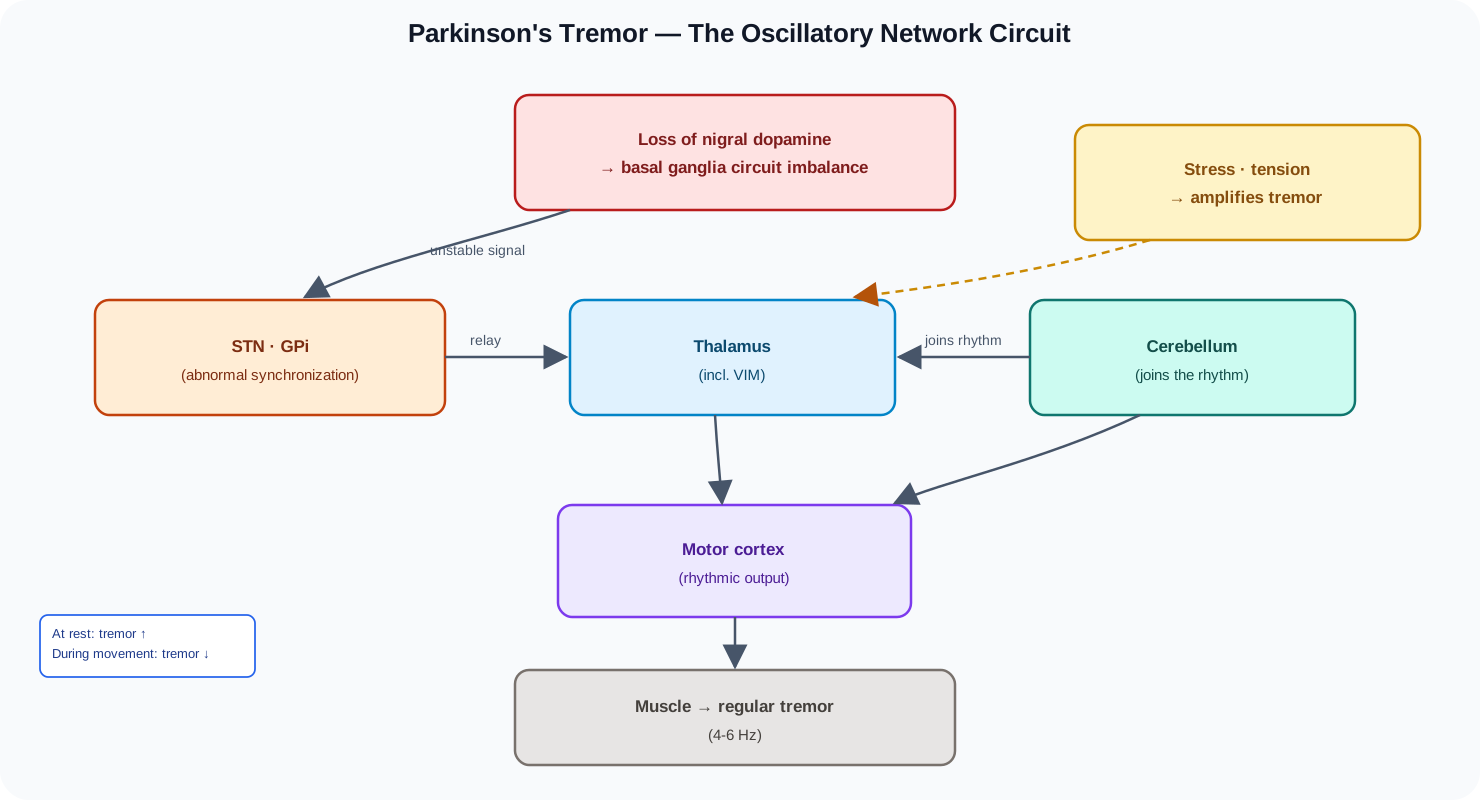
Figure. Parkinsonian tremor as an oscillatory network. Abnormal synchronized activity in basal ganglia circuits interacts with thalamic, cerebellar, and cortical activity to produce rhythmic tremor. Stress and arousal can amplify the network.
1. Tremor does not move in parallel with the other symptoms
The major motor features of Parkinson’s disease are commonly described as bradykinesia, rigidity, rest tremor, and postural instability.
But in real patients, tremor does not always track the other symptoms.
One person can have severe bradykinesia and almost no tremor.
Another can walk relatively well but have a very prominent hand tremor.
After medication, slowness may improve while tremor remains, or tremor may improve first.
This suggests that tremor is not generated by exactly the same mechanism as bradykinesia or rigidity.
2. Why is rest tremor most visible at rest?
The classic Parkinsonian tremor often appears when the hand is resting.
When the hand is placed on the lap, the fingers or wrist may shake rhythmically.
When the patient reaches for an object or starts a voluntary movement, the tremor may lessen.
This is rest tremor.
In real patients, postural or action tremor may coexist as well.
During voluntary movement, the motor cortex, cerebellum, and sensory feedback systems are actively engaged.
When the body is still, a particular oscillatory network may become relatively more visible.
So tremor is not simply weak muscle shaking. It is closer to a rhythmic activity generated by brain circuitry itself.
3. Tremor is oscillation
The key concept is oscillation.
Neurons do not work independently one by one.
Large groups of neurons are connected and can fire together in rhythmic patterns.
Rhythms also exist in the normal brain.
But when abnormal synchronization develops in a particular network, that rhythm can be expressed as movement of the muscles.
Parkinsonian tremor can be understood in this way.
The important question is not simply whether neurons fire more or less, but whether many neurons begin firing repeatedly in the same beat.
4. The basal ganglia may help initiate the tremor
As dopamine neurons in the substantia nigra are lost, the balance of the striatum and basal ganglia changes.
The direct and indirect pathways shift, and the activity of the STN and GPi changes as well.
These circuit changes are central to bradykinesia and rigidity.
The basal ganglia also appear to play an important role in tremor.
Rather than producing the entire tremor by themselves, they may help initiate an unstable signal that is then transmitted into other circuits.
5. The cerebellum also participates
It is difficult to discuss tremor without the cerebellum.
The cerebellum normally corrects movement error and adjusts timing.
That is highly useful in normal movement.
But when rhythmic abnormal activity enters the system, the cerebellum can also become entrained by that rhythm.
The cerebellum → thalamus → motor cortex pathway may contribute to maintaining and expressing the tremor.
So Parkinsonian tremor is best understood through the interaction between basal ganglia and cerebellar circuits.
6. Two circuits meet
One useful model is that basal ganglia circuitry helps trigger the tremor while the cerebellum-thalamus-cortex circuit helps sustain or amplify it.
In simplified form:
An unstable signal begins in the basal ganglia.
↓
It is relayed through the thalamus toward the motor cortex.
↓
The cerebellar circuit joins the rhythm.
↓
Rhythmic motor cortical output reaches the muscles.
↓
A regular tremor appears in the hand or arm.
The real brain is much more complex, but the important point is not to reduce tremor to a single anatomical site.
7. Why does stress make tremor worse?
Many people with Parkinson’s disease notice that tremor becomes stronger with tension or anxiety.
It may worsen when seeing a doctor, speaking in front of others, concentrating, or becoming emotionally tense.
This shows that the tremor network is not isolated from emotion and arousal.
The limbic system, prefrontal cortex, and autonomic nervous system can all influence basal ganglia and thalamic activity.
So tremor can vary with emotional state.
It is not a tremor that can simply be stopped by willpower.
As arousal rises, the tremor network may become easier to activate.
8. Why can one hand tremble more while walking?
Parkinson’s disease often begins asymmetrically.
Tremor also commonly begins in one hand first.
During walking, one arm may swing less naturally while the fingers or wrist on that side tremble more prominently.
This reflects the fact that nigrostriatal degeneration and basal ganglia circuit changes do not necessarily begin equally on both sides.
So tremor can also emerge asymmetrically.
9. Tremor responds differently to medication
Bradykinesia and rigidity often respond relatively well to levodopa.
Tremor response is more variable.
Some tremors respond very well.
Others remain prominent even when the medication effect is otherwise good.
This is another clue that tremor is not determined by striatal dopamine concentration alone.
Dopamine clearly matters, but the established oscillatory network also involves the thalamus, cerebellum, motor cortex, and sensory feedback systems.
10. Tremor and dyskinesia are different
Both can look like “too much movement,” so patients and caregivers may confuse them.
But the movement pattern is different.
Tremor is relatively regular and rhythmic.
Dyskinesia is often flowing, writhing, twisting, or irregular.
The mechanisms differ as well.
Dyskinesia is strongly related to repeated dopaminergic stimulation and hypersensitive striatal plasticity.
Tremor is more closely related to an oscillatory network spanning the basal ganglia and the cerebellum-thalamus-cortex system.
11. This is where DBS targets begin to make sense
This leads naturally to the next question.
If tremor is an oscillatory network, could we reduce tremor by modulating an important node in that network?
This is one way to understand DBS.
DBS may target basal ganglia structures such as the STN or GPi, and in selected situations may target thalamic regions closely linked to tremor circuitry.
DBS is not simply a treatment that “puts electricity into the brain to make the body move.”
It is better understood as a treatment that changes the pattern of abnormally synchronized neural activity.
Once that is clear, the logic behind target selection becomes much easier to understand.
Tremor, understood through the body
Living with Parkinson’s disease for a long time, I have noticed that symptoms do not always move together even within the same day.
The body can be stiff while tremor is severe.
The body can loosen somewhat while tremor remains.
Tension can suddenly make tremor larger.
That makes it difficult to think of Parkinson’s disease only as “a disease in which dopamine falls and the body becomes slow.”
I now see tremor differently.
Tremor is not simply the muscle shaking.
It may be the result of an unstable signal beginning in the basal ganglia and becoming a rhythm as it circulates through the thalamus, cerebellum, and motor cortex.
So Parkinsonian tremor arises from the same disease as bradykinesia and rigidity, but it is expressed through a somewhat different circuit.
Part 7 in one line
Parkinsonian tremor can be understood not simply as the result of dopamine deficiency, but as a symptom that emerges when unstable basal ganglia activity interacts with the cerebellum-thalamus-motor cortex network and forms an abnormal oscillatory circuit.