Appendix 2. Multiple System Atrophy (MSA)
— Why do the autonomic nervous system and the motor system break down together?
Among the parkinsonian syndromes, multiple system atrophy (MSA) is one of the disorders most often compared with Parkinson’s disease.
Its name says something important: this is not a disease of one neural system alone. Several systems can be affected together.
The body may become slow and rigid, much like in Parkinson’s disease. But autonomic function can also fail early and prominently.
Orthostatic hypotension, urinary dysfunction, sexual dysfunction, sweating abnormalities, and constipation may appear around the same time as the motor syndrome, or sometimes stand out even earlier.
That is one reason studying MSA also makes Parkinson’s disease easier to understand.
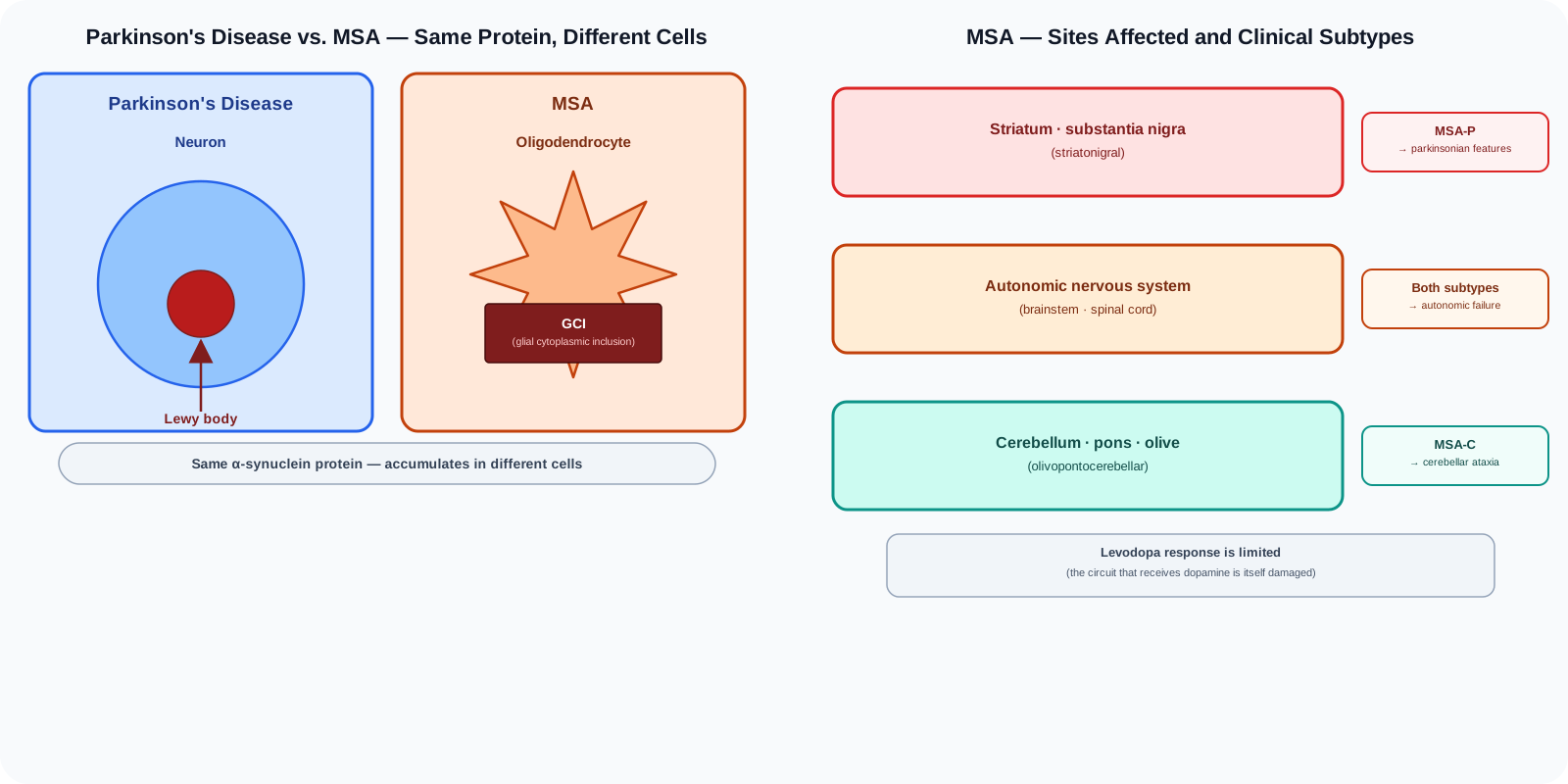
Figure. Parkinson’s disease and MSA both involve α-synuclein, but the dominant cell type and the distribution of degeneration differ.
1. MSA is one disease, but several systems are involved
Two broad clinical patterns are commonly described.
MSA-P is dominated by parkinsonian features such as bradykinesia, rigidity, and gait impairment.
MSA-C is dominated by cerebellar features such as gait ataxia, limb ataxia, and dysarthria.
In real patients, however, these patterns are not perfectly separate and may overlap.
A major feature in both is autonomic dysfunction.
2. It can begin looking very much like Parkinson’s disease
Early MSA-P can resemble Parkinson’s disease closely.
The body becomes slow and rigid, the stride shortens, and posture may become flexed.
For that reason, some patients are initially thought to have Parkinson’s disease.
With time, differences often become clearer. MSA tends to progress faster, autonomic dysfunction often becomes prominent earlier, and levodopa responsiveness is commonly weaker or less sustained.
Still, some patients can respond to levodopa early on. A small response by itself does not settle the diagnosis.
3. Why are autonomic symptoms so important?
One of the central features of MSA is involvement of the autonomic nervous system.
Marked orthostatic hypotension, urinary dysfunction, urinary retention or frequency, and sexual dysfunction can appear relatively early.
Normally, standing up triggers rapid autonomic vasoconstriction to maintain blood pressure.
If that control system fails, blood pressure can fall on standing, causing dizziness, blurred vision, weakness, or even syncope.
When severe autonomic symptoms appear early in a parkinsonian syndrome, MSA becomes an important consideration.
4. Bladder dysfunction also matters greatly
Urinary problems can appear early in MSA.
Urgency and frequency may come first. As the disease progresses, incomplete emptying, large post-void residuals, or urinary retention can develop.
Urinary urgency and frequency also occur in Parkinson’s disease, but in MSA the dysfunction may be earlier, more severe, and more complex.
So the question when did the bladder problem begin? can be diagnostically useful.
5. What changes when the cerebellum is involved?
In MSA-C, cerebellar dysfunction is prominent.
A person may overshoot a target with the hand, walk with a wide and unsteady base, have poor balance, or develop scanning or slurred speech.
This feels different from the typical bradykinesia and rigidity of Parkinson’s disease.
The basal ganglia are important for initiating movement and scaling its size. The cerebellum is especially important for accuracy and timing.
So the same complaint — “walking is difficult” — can come from a different circuit problem.
6. The pathological hallmark involves α-synuclein
Parkinson’s disease and MSA are different disorders, but both belong to the group of α-synucleinopathies.
The major pathological difference is where the abnormal protein accumulates.
In Parkinson’s disease, α-synuclein is found mainly in neurons, forming Lewy bodies and Lewy neurites.
In MSA, α-synuclein accumulates predominantly in oligodendrocytes, forming glial cytoplasmic inclusions (GCI).
That distinction matters.
The same protein can be involved, but the cell in which it accumulates is different.
7. Why do oligodendrocytes matter?
Oligodendrocytes form and maintain myelin around axons in the central nervous system.
They help neurons transmit signals rapidly and reliably.
In MSA, abnormal α-synuclein accumulates in these cells.
That means the problem may extend beyond the function of a single neuron and involve axonal maintenance, myelin, and neuron-glia interactions.
This broader disruption can contribute to degeneration across several neural systems.
That is why the name multiple system atrophy fits the disease so well.
8. Which regions degenerate pathologically?
Different symptoms reflect degeneration in different systems.
When parkinsonism dominates, degeneration of the striatum and substantia nigra is important.
When cerebellar symptoms dominate, the pons, cerebellum, and inferior olive may be heavily involved.
Autonomic symptoms reflect degeneration in autonomic structures of the brainstem and spinal cord.
MSA can therefore be understood as a disease combining striatonigral degeneration, olivopontocerebellar degeneration, and autonomic degeneration.
9. MSA-P and MSA-C are pathologically connected
MSA-P is associated with more prominent striatonigral degeneration, so parkinsonian symptoms dominate.
MSA-C is associated with more prominent olivopontocerebellar degeneration, involving the inferior olive, pons, and cerebellum, so cerebellar ataxia stands out.
These are not completely separate diseases.
They are different clinical expressions of one disorder, depending on which systems are more severely affected.
10. Why is the levodopa response often limited?
In Parkinson’s disease, substantia nigra dopamine neurons are lost, but enough of the striatal receptor and downstream circuitry can remain functional for a long time.
That is why replacing dopamine with levodopa can produce a substantial motor response.
In MSA, the problem is not confined to the substantia nigra. The striatum itself and downstream networks can also degenerate.
If the circuit that should receive and process dopamine is damaged, supplying levodopa alone may not restore function well.
For that reason, levodopa responsiveness is often weaker or incomplete in MSA.
11. Why is DBS usually a poor fit?
This difference also matters when thinking about DBS.
In Parkinson’s disease, a levodopa-responsive motor circuit often remains functionally modifiable. Adjusting abnormal activity in the STN or GPi can therefore produce major benefit.
In MSA, degeneration is more widespread.
Basal ganglia, cerebellar, brainstem, and autonomic networks may all be involved.
Stimulating one node cannot correct all of those failing systems.
Typical MSA is therefore generally not considered a good indication for DBS.
12. Breathing and laryngeal symptoms can be important
Some patients with MSA develop characteristic breathing problems.
One important clue is stridor, a high-pitched harsh breathing sound that may be especially noticeable during sleep.
It can be related to abnormal laryngeal and vocal-cord control.
This kind of nighttime breathing problem should not simply be dismissed as snoring.
Brainstem and autonomic involvement in MSA can affect respiratory control as well.
13. Posture and neck abnormalities can also be clues
Some patients develop marked forward flexion of the neck, called antecollis.
Dystonia can also affect the trunk or limbs.
These findings are not diagnostic by themselves, but in the right clinical context they can add to the pattern suggesting MSA.
The whole pattern matters more than any single sign.
14. What can MRI show?
MRI can support the diagnosis of MSA.
In MSA-C, atrophy of the pons and cerebellum may be seen.
Some patients show the well-known hot cross bun sign, a cruciform signal abnormality in the pons.
In MSA-P, putaminal atrophy or signal changes may be present.
These findings are not absolute. MRI can be unrevealing early, and similar findings can occasionally occur in other disorders.
Imaging therefore supports the clinical diagnosis; it does not replace it.
15. The most important difference between Parkinson’s disease and MSA
Put very simply, Parkinson’s disease is centered mainly on dysfunction of the nigrostriatal dopaminergic system.
It often responds relatively well to levodopa and usually progresses more slowly.
MSA involves multiple systems — basal ganglia, autonomic nervous system, cerebellum, and brainstem.
Levodopa responsiveness is often more limited, and autonomic or other neurological features may become prominent earlier.
Looking again at Parkinson’s disease and MSA through pathology
One point is especially striking to me.
Parkinson’s disease and MSA can have very different clinical courses even though both are related to the same protein, α-synuclein.
In Parkinson’s disease, the protein accumulates mainly in neurons.
In MSA, it accumulates predominantly in oligodendrocytes.
The same protein can produce a very different disease depending on which cell, which circuit, and which distribution are involved.
That is an important way to think about neurodegenerative disease.
Understanding MSA makes Parkinson’s disease easier to see
Parkinson’s disease can also cause constipation, orthostatic hypotension, and urinary symptoms.
But in MSA, these autonomic symptoms can become prominent much earlier and more severely.
Parkinson’s disease can also lead to balance problems, but MSA may involve the cerebellum and brainstem much earlier.
Parkinson’s disease involves loss of dopamine neurons, whereas MSA can also damage the circuits that must receive and process dopamine.
So even when the visible parkinsonian symptoms look similar, where the disease starts and how widely it spreads can be very different.
That difference helps explain the differences in medication response and prognosis.
Appendix 2 in one line
Multiple system atrophy (MSA) is an α-synucleinopathy in which α-synuclein accumulates predominantly in oligodendrocytes; because basal ganglia, autonomic, cerebellar, and brainstem systems can degenerate together, parkinsonian motor symptoms may be accompanied by severe early autonomic dysfunction and cerebellar signs.