This article is a record of one patient’s self-observation. It is not a study that measured blood levodopa concentration, and it is not meant to encourage anyone to change the dose, timing, or combination of medications on their own.
Two Evenings That Looked Alike but Were Different
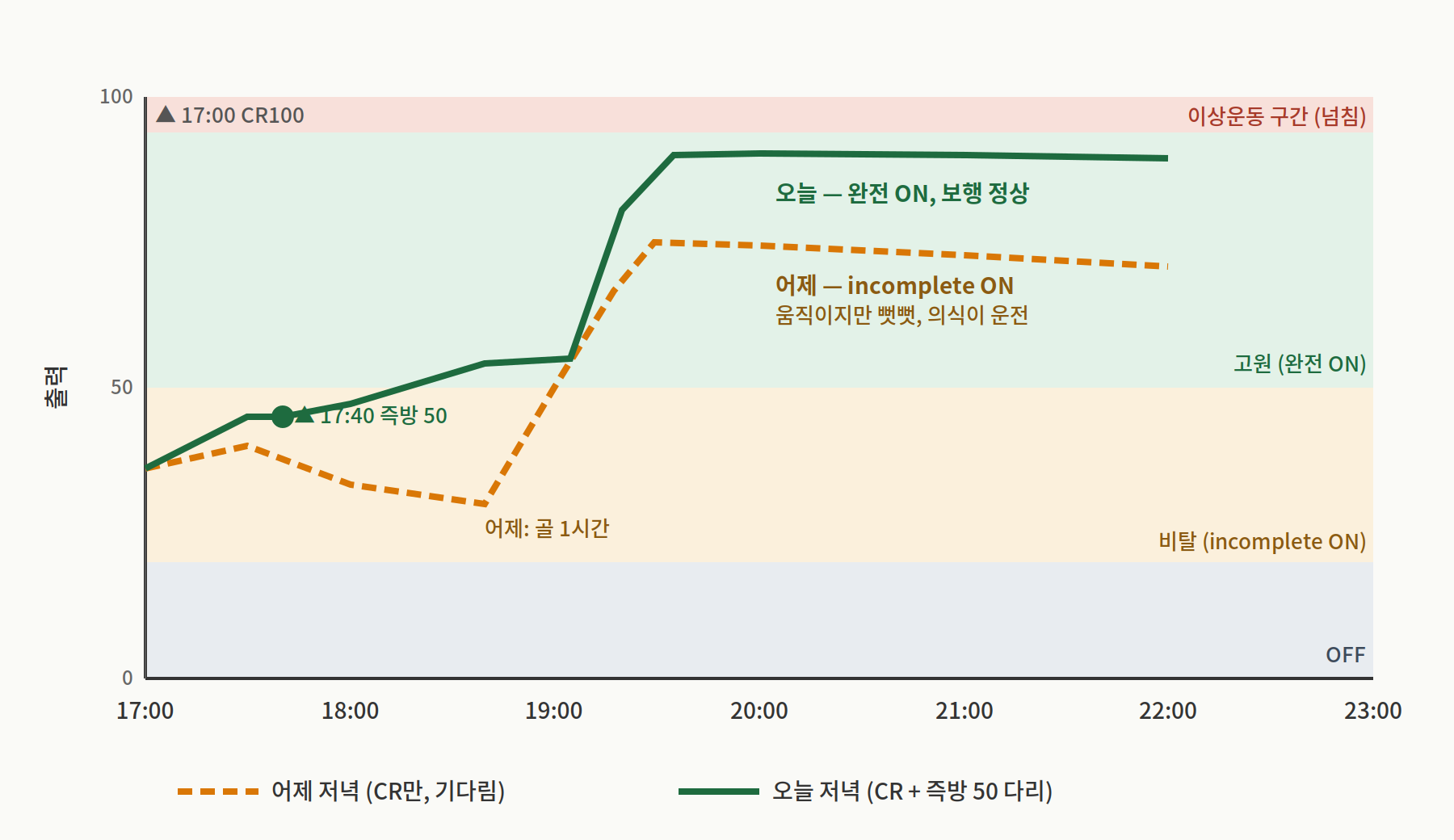
Looking only at the log, yesterday evening and tonight looked similar.
I took the same extended-release levodopa, Perkin CR 100 mg, at the same time on both days. The signal of the medication’s effect came at about the same time, and I could move to some degree until I fell asleep. Going only by the log’s classification, both evenings were ON.
But the quality of the two evenings, as I experienced them in my body, was different.
Yesterday I could walk, but my legs were stiff. I had to consciously direct each step. Tonight, after taking immediate-release Perkin 50 mg at the trough, my gait became noticeably more natural. Yesterday felt like I was running down a battery just to hold on; tonight I could get through it while spending less of myself.
It is possible that this small extra dose made a real difference. But three days of observation are not enough to conclude that the 50 mg was the direct cause. Meals, gastric emptying, sleep, activity level, the residual effect of the previous dose, and the natural variability of Parkinson’s disease itself may all have played a part as well.
The purpose of this article is not to declare a single right answer. It is to build a hypothesis that could explain the difference between the two evenings, and to make clear what to check for in the next round of records.
ON Is Not a Full On/Off Switch — It’s a Continuous Response with a Threshold
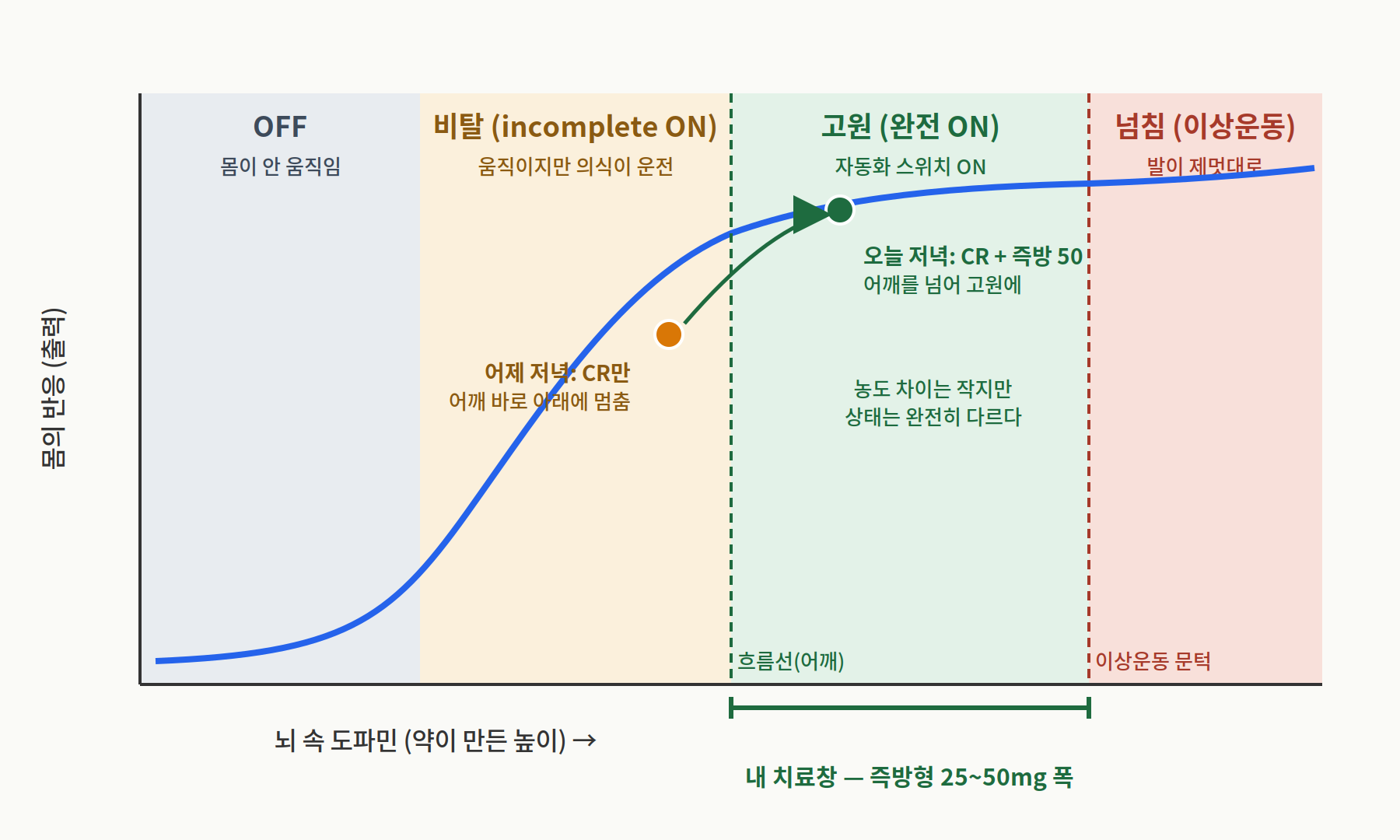
For a long time I thought of medication effect like a dial. More drug meant brighter, less meant dimmer, and I assumed everything in between changed smoothly.
The actual experience was a little different.
The state of my body changed continuously, but past a certain point, movement seemed to suddenly become easier. In advanced Parkinson’s disease, the gap between the lower boundary where effect appears and the upper boundary where dyskinesia begins can narrow, so even a small change may be felt strongly.
That does not mean ON can be treated as a true on/off switch. The switch is a metaphor for describing my experience. What I’ve called incomplete ON is more accurately described not as a simple “OFF that can still move,” but as a partial response — one in which only some motor symptoms improved, or daily function did not recover enough.
My body’s ON changes continuously, but crossing a specific threshold makes function feel like it suddenly improves.
The Difference Felt Above and Below the Shoulders
The biggest difference between the two evenings was the automaticity of my gait.
When my state improved enough, my feet moved forward without my having to think about it. When the improvement was incomplete, I had to consciously direct each step. Looking only at whether I could walk, both were ON — but the cost my body paid was not the same.
This difference may be the combined result of several factors — bradykinesia, rigidity, postural instability, fatigue, and attention, among others. It could also be explained in terms of basal ganglia circuits and automaticity, but a personal record alone cannot prove that a switch in some specific circuit was turned on.
So this is how I write it now.
Not “the automaticity switch turned on,” but “gait automaticity felt like it recovered.”
Did the Speed of the Rise Matter, Not Just the Height of the Effect?
Extended-release formulations rise slowly, while immediate-release formulations are absorbed relatively quickly. It is possible that the immediate-release 50 mg helped me reach the level I needed faster than CR alone would have.
But there is no basis for concluding that a fast rise in concentration created some separate signal that flipped a switch in the brain. The difference that day could be explained not only by the immediate-release drug’s fast absorption, but also by the increase in total levodopa exposure, the state of the gastrointestinal tract, or natural variability.
So I am leaving this observation as a hypothesis, not a conclusion.
Hypothesis: On a night when evening CR 100 mg alone did not lead to sufficient functional recovery, immediate-release 50 mg may have helped me reach the level I needed sooner.
Why the Same CR 100 mg Produced Different Results
Over three days I took the same CR 100 mg at several different times, and the response was different each time.
- In the morning, the response was late and shallow.
- In the afternoon, it overlapped with dyskinesia.
- In the evening, it felt more stable on the day I added immediate-release.
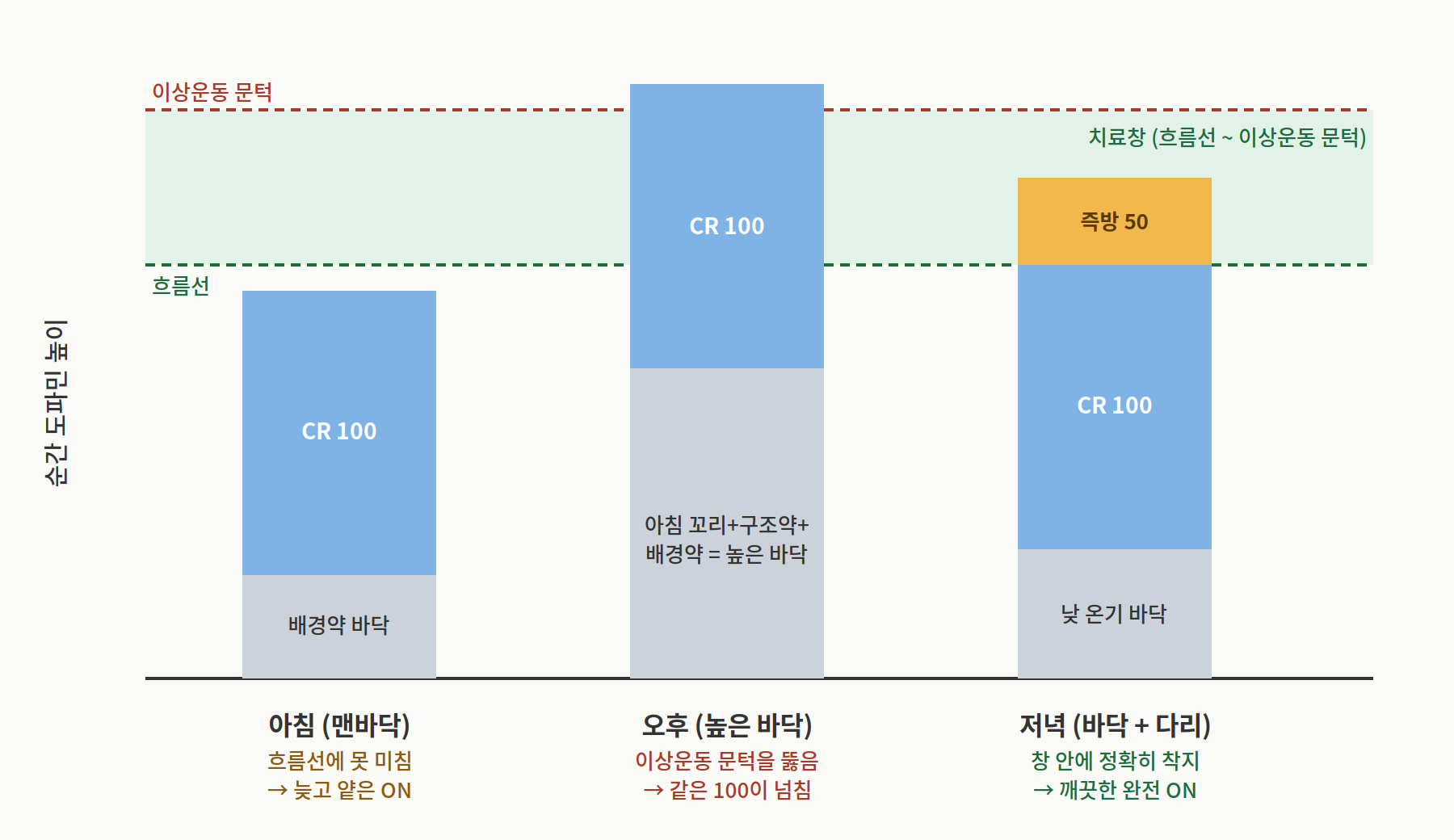
The same pill may have produced different results because the conditions at the time of dosing were different.
The residual effect of the previous dose, the increase in levodopa exposure from opicapone, meals and protein, the speed of gastric emptying, constipation, sleep, activity level, and time-of-day variation are all candidates. The phrase I’ve used, “a higher floor,” is a personal model for bundling these conditions together into one explanation.
The observation that morning dyskinesia decreased after I stopped opicapone is meaningful too. But that alone cannot confirm that opicapone’s residual effect was the cause. Even though opicapone’s plasma half-life is relatively short, its effect on COMT inhibition and levodopa exposure may last longer. At the same time, other medications and life circumstances may have changed as well.
Not “Measuring” the Therapeutic Window, but Seeing a Zone Where Response Was Sensitive
In this record, even a small difference of about 25-50 mg of immediate-release levodopa was felt strongly. But an oral dose and brain dopamine concentration do not correspond one to one. The effect of the same dose can vary depending on absorption rate, gastric emptying, food, concomitant medications, and the previous dose.
So I cannot say, “My therapeutic window is 25-50 mg.”
A more accurate way to put it is this.
Within the current range of records, my response appeared sensitive enough that a change of even 25-50 mg could shift how I felt.
This is a tentative estimate that needs repeated recording and review by my treating clinician.
My Clock, as Observed Over Three Days
| Formulation and condition | Time observed | Interpretation from this record |
|---|---|---|
| CR 100 mg, morning alone | First sign at about 85 min; sufficient improvement at about 215 min, held for about 30 min | On this day the response was late and short. It cannot be generalized as CR’s typical effect. |
| CR 100 mg, evening | Held, by feel, for 6-7 hours in one observation | May have been favorable as an evening maintenance dose. |
| Immediate-release 50 mg, fasting | First sign at about 15 min; sufficient improvement at about 50 min | May have acted as a rescue dose. |
| Immediate-release 50 mg, after a meal | Sufficient improvement at about 105 min | The meal or delayed gastric emptying may have played a role. |
| Immediate-release 75 mg, morning | Sufficient improvement was about 70 min faster than the previous day | A single observation; needs repeated confirmation. |
This table reflects three days of personal observation. It is not a standard pharmacokinetic figure or a prescribing standard for other patients.
“Take It Now, or Wait?” Is Not a Self-Dosing Rule
The first draft of this article included a rule for adding immediate-release 25-50 mg depending on symptoms. On review, I deleted that sentence.
The absence of dyskinesia alone cannot confirm that levodopa is insufficient. Stiffness or gait hesitation do not always mean a low-dopamine state either. Dyskinesia itself is interpreted differently depending on whether it follows a peak-dose or diphasic pattern, so timing alone makes it hard to accurately judge drug concentration.
| State being observed now | Possible interpretation | Safe response |
|---|---|---|
| New or worsening dyskinesia | Possibly increased dopaminergic stimulation; varies by form and timing | Do not automatically decide to take an extra dose; record the time, duration, and the preceding dose and meal. |
| Movement worsens without dyskinesia | Could be wearing-off, but also fatigue, anxiety, pain, or freezing of gait | Reduce fall risk, and follow a rescue-dose plan only if one has already been agreed on with the treating clinician. |
| Feels like ON but the legs are stiff or hesitant | Could be a partial response, axial symptoms, freezing of gait, or a non-dopaminergic factor | Prioritize safety measures such as cueing and walking aids, and review the repeating pattern at the next visit. |
Any additional dose needs to take into account the individual’s prescribed range, the day’s total amount, the timing of the previous dose, dyskinesia, and the risk of hallucinations and low blood pressure, all together.
Toe Curling May Be a Marker, but It Doesn’t Tell You Which Direction
Over three days, toe curling appeared several times around the moments when the medication’s effect was changing. For me, it may be a marker of a transition.
But toe dystonia can appear not only in OFF, but also while the effect is rising or falling, and sometimes even during ON. Toe curling alone should not be used to conclude “ON is coming soon” or “OFF is coming soon.”
To tell the direction apart, I need to record together the time the curling started, which side, pain, the preceding dose, the gait state at the time, and how things changed over the following 30-60 minutes.
The Next Questions Left by Three Days of Records
The daily medication schedule that was in the original draft risked reading like a fixed prescription, so I changed it into questions to review at my next visit.
- Does the response to morning CR 100 mg alone stay repeatedly late and short?
- Does the faster improvement after adding morning immediate-release reproduce consistently?
- How much does the rescue dose’s response time differ before and after a meal?
- Does dyskinesia after the afternoon CR dose vary depending on the interval from the previous dose?
- Do evening CR alone and the CR-plus-immediate-release combination show a reproducible difference in gait quality?
- How do good ON and dyskinesia each change when opicapone is kept or adjusted?
Any actual change should be discussed with the treating neurologist and checked one variable at a time.
Records Don’t Give Answers — They Create the Next Question
Until three days ago, I mostly judged the medication’s effect by feel. After I started keeping records, I could lay dose time, meals, the first sign, sufficient improvement, dyskinesia, and toe curling on the same timeline.
Records don’t prove a cause outright. Instead, they show a repeating pattern and the next question to test.
The most important finding in this record is not the conclusion that “immediate-release 50 mg is always the answer.” It’s that the same dose felt entirely different depending on the time of day, meals, the previous dose, and concomitant medications. And it’s that gait automaticity and fatigue turned out to matter enough that being able to walk, on its own, is hard to call a sufficient ON.
This is one person’s map, and it cannot be generalized directly to other patients. But the difference between the two evenings was clear. Perhaps what matters in Parkinson’s pharmacology is not only how much you take, but also seeing what condition the body is in when that dose lands.
Medical Safety Notice This article is one patient’s personal record and interpretation, not medical advice or a prescription. Any change to the dose, timing, or combination of medications such as levodopa, opicapone, dopamine agonists, or amantadine must be discussed with the treating clinician. Sudden worsening of gait, repeated falls, severe dyskinesia, hallucinations or confusion, fainting, or severe low blood pressure require immediate medical evaluation. The medication-effect curve in the app is not a measured blood concentration; it is an estimated line based on dosing time and formulation characteristics.